
Chromium-6 in Southern California Water: The Complete Guide
Detected in utilities across all seven SoCal counties. Here is what public data shows, how levels compare to California's health goal, and what removes it.
Chromium-6 (hexavalent chromium) is detectable in tap water across all seven Southern California counties. The Environmental Working Group's Tap Water Database, which aggregates monitoring data submitted to the California State Water Resources Control Board, documents detections above California's 0.02 ppb public health goal in utilities serving Los Angeles, Orange, San Diego, Riverside, San Bernardino, Ventura, and Imperial counties. LADWP's Consumer Confidence Reports document detections ranging from 0.10 to 0.40 ppb in Los Angeles service areas, against a California public health goal of 0.02 ppb set by the Office of Environmental Health Hazard Assessment. These levels fall below the enforceable Maximum Contaminant Level of 10 ppb re-established in October 2024, but remain substantially above the health-protective benchmark. This guide summarizes publicly available regulatory and monitoring data and explains the treatment options independently verified to reduce hexavalent chromium in residential drinking water.
October 2024: California re-established a chromium-6 MCL
Following a 2017 legal challenge that suspended the original 10 ppb rule, California adopted a new Maximum Contaminant Level for hexavalent chromium in October 2024, again set at 10 ppb. All regulated utilities must meet this limit. California's public health goal (PHG) of 0.02 ppb, set by OEHHA, is a health-protective benchmark and is not an enforcement limit.
Cleaner water at every tap by sundown. No upsell theater.
Free water test in your kitchen. Lab report in 24 hours. 5-year warranty. 90-day money-back.

What is chromium-6 and why is it present in Southern California water?
Chromium-6, or hexavalent chromium, is a form of the element chromium that dissolves readily in water and is classified as a known carcinogen by the International Agency for Research on Cancer and the California Office of Environmental Health Hazard Assessment. It enters water supplies through two main pathways in Southern California: industrial discharge and natural geology.
The industrial pathway is concentrated in the Los Angeles Basin and San Gabriel Valley, where mid-20th-century manufacturing left a legacy of chromium contamination in soil and groundwater. Chrome plating, aerospace component manufacturing, metal finishing, and leather tanning operations discharged chromium compounds over decades. The EPA designated four Superfund sites in the San Gabriel Basin beginning in 1984 to address this contamination, and cleanup is ongoing as of 2024. A detailed guide to chromium-6 in the San Gabriel Valley covers the specific Superfund areas and affected cities.
The natural geology pathway affects a much larger region. Chromium occurs in ultramafic rock formations widespread across California's Coast Ranges and the Klamath Mountains. Weathering releases chromium into groundwater and surface water, which then enters municipal supplies. This natural source means that utilities with no significant industrial history still report chromium-6 detections. Colorado River water, the primary supply source for much of Southern California, carries detectable chromium-6 from geological sources along its 1,450-mile corridor through the Colorado Plateau.
What chromium-6 levels does public data show for Southern California tap water?
The most granular public data on chromium-6 in Southern California comes from three sources: individual utility Consumer Confidence Reports (CCRs), the California State Water Resources Control Board's Safe Drinking Water Information System (SDWIS), and the Environmental Working Group's Tap Water Database, which aggregates and displays SDWIS monitoring records.
LADWP's CCRs document hexavalent chromium detections across Los Angeles service areas ranging from 0.10 to 0.40 ppb. The utility operates treatment steps designed to meet the 10 ppb MCL; the detections reported are well below the enforcement limit but up to 20 times higher than the 0.02 ppb public health goal. LADWP publishes current data at ladwp.com.
The EWG Tap Water Database, drawing on state-reported monitoring records, documents hexavalent chromium detections above the 0.02 ppb PHG in the majority of Southern California utilities across all seven counties. Detections above the 10 ppb MCL are rare among regulated municipal systems, but the large gap between the legal limit (10 ppb) and the health-protective goal (0.02 ppb) means that compliance with the MCL does not mean water is at or below the health benchmark.
| Standard | Level | Authority | Notes |
|---|---|---|---|
| California Public Health Goal (PHG) | 0.02 ppb | California OEHHA | Health-protective benchmark; not an enforcement limit. Set at the level below which no known carcinogenic risk exists. |
| California Maximum Contaminant Level (MCL) | 10 ppb | California State Water Resources Control Board | Re-established October 2024. Enforceable limit that all regulated utilities must meet. |
| EPA MCL (total chromium) | 100 ppb (0.1 mg/L) | U.S. Environmental Protection Agency | Federal limit covers all chromium forms combined. No federal MCL specific to hexavalent chromium as of 2024. |
Which Southern California counties and utilities have the most documented chromium-6 detections?
Chromium-6 is not concentrated in one part of Southern California. Public monitoring data shows detections across the region, though the character of contamination differs by county:
- Los Angeles County: Two overlapping contamination profiles. Industrial contamination from the San Gabriel Basin Superfund areas affects communities in the eastern San Gabriel Valley. Natural-source chromium-6 affects utilities drawing on MWD-imported Colorado River water throughout the county. LADWP reports 0.10 to 0.40 ppb across its service territory.
- Orange County: Utilities operating under the Orange County Water District blend, including the Groundwater Replenishment System, report chromium-6 through SDWIS. The OCWD's advanced purified water process applies reverse osmosis at scale, which removes chromium-6, but distribution blending with imported water reintroduces detectable levels.
- San Diego County: The San Diego Water Authority system draws primarily on Colorado River water and State Water Project water. Both carry naturally occurring chromium-6. SDWIS records document detections across San Diego County utilities above the 0.02 ppb PHG.
- Riverside and San Bernardino counties: Inland Empire utilities drawing on local groundwater in the Santa Ana watershed and imported MWD water both show chromium-6 detections. Groundwater in portions of the IE has historically shown contamination from both industrial and natural sources.
- Ventura County: Utilities drawing on Casitas MWD and Calleguas Municipal Water District supplies, which blend Colorado River and State Water Project water, report detections consistent with regional patterns.
- Imperial County: Imperial Irrigation District draws directly from the Colorado River. Chromium-6 detections follow the river source profile.
The most authoritative current data by utility is available in the California Drinking Water Watch database (waterboards.ca.gov) and in each utility's annual Consumer Confidence Report.
Does a water filter remove chromium-6 from tap water?
Not all filters reduce chromium-6. The effectiveness depends on the technology and its NSF certification. Standard activated carbon filters, including most pitcher and faucet filters rated under NSF/ANSI Standard 42, are not tested or certified for hexavalent chromium removal. The two technologies independently verified to reduce chromium-6 are reverse osmosis and strong-base anion exchange.
| Technology | NSF Standard | Chromium-6 Reduction | Coverage |
|---|---|---|---|
| Reverse Osmosis (Point-of-Use, Under-Sink) | NSF/ANSI 58 | 90 to 97 percent (typical at municipal concentrations) | Drinking and cooking water at a single tap |
| Strong-Base Anion Exchange (Whole-Home) | NSF/ANSI 61 (system components) | High; effectiveness varies by chromate loading and regeneration cycle | All taps and fixtures throughout the home |
| Activated Carbon Block or Pitcher Filter | NSF/ANSI 42 (taste and odor only) | Not effective; not certified for chromium-6 removal | Not applicable for this contaminant |
Source: NSF International product certification registry at nsf.org. Verify any specific product's certification and listed contaminant claims in the NSF registry before purchase.
How does a reverse osmosis system reduce chromium-6?
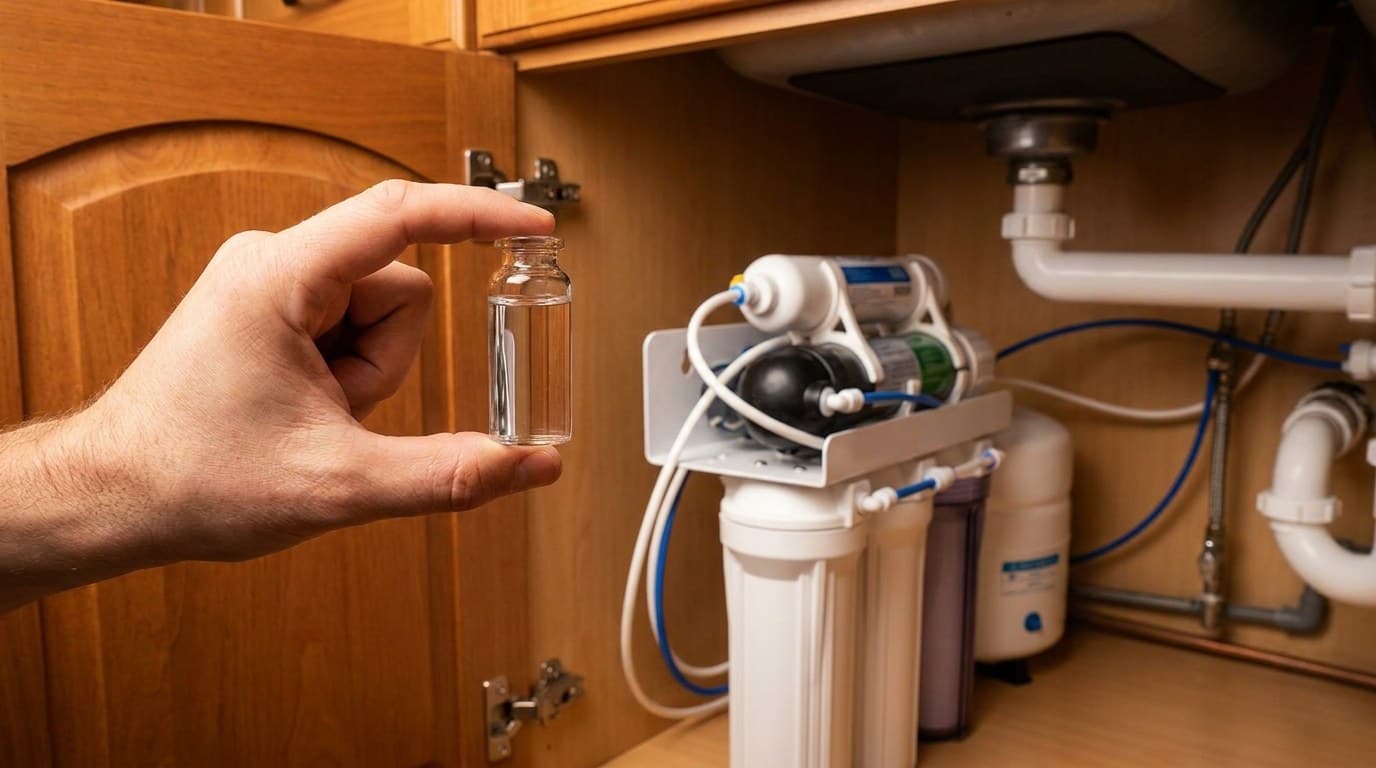
A certified reverse osmosis (RO) system pushes water through a semipermeable membrane under pressure. The membrane rejects dissolved ions including chromate, the primary form in which chromium-6 travels in water. In independent testing conducted for NSF/ANSI Standard 58 certification, RO membranes reduce hexavalent chromium by 90 to 97 percent from the feedwater at concentrations typical in Southern California municipal supplies.
An under-sink RO system installed at the kitchen tap treats drinking and cooking water. It does not treat all water in the home; shower and laundry water are not covered by a point-of-use unit. For whole-home chromium-6 reduction, strong-base anion exchange is the primary technology, though it is more complex and expensive than a point-of-use RO system and is more common in commercial and industrial contexts.
The reverse osmosis systems we install carry NSF/ANSI 58 certification. An RO system for a typical SoCal home also removes arsenic, nitrate, fluoride, and total dissolved solids (TDS), making it a practical multi-contaminant solution for SoCal tap water.
How do I find the chromium-6 level in my specific water supply?
Three public resources give you utility-specific chromium-6 data:
- Your utility's Consumer Confidence Report (CCR): California law requires every regulated water system to publish an annual CCR listing all detected contaminants including hexavalent chromium. Search your utility's name plus "Consumer Confidence Report" or "water quality report." The CCR is the primary regulatory document and includes the reporting period, detection range, MCL, and the utility's compliance status.
- California Drinking Water Watch (waterboards.ca.gov): The State Water Resources Control Board maintains a searchable database of monitoring results by public water system. You can search by water system name or Public Water System ID (PWSID) to access raw testing records beyond what appears in the CCR. Access the raw data download portal here.
- EWG Tap Water Database (ewg.org/tapwater): EWG aggregates SDWIS records and displays them in a searchable format by utility. This is useful for a quick overview, though it may lag state records by one to two reporting cycles. Always cross-check against the current CCR for the most recent data.
If your home uses a private well, you are not covered by utility monitoring requirements. Arrange testing through a California ELAP-certified laboratory and test specifically for hexavalent chromium rather than only total chromium, as total chromium results may not distinguish the hexavalent form.
Schedule your free water test.
A SoCal Water Treatment tech tests your kitchen tap for chromium-6, arsenic, hardness, and total dissolved solids. Independent lab confirmation in 24 hours. You see the numbers before you see a quote.
Request your free water test and we will confirm a window with you directly, usually within the hour.
Find out the chromium-6 level at your tap. Free water test. Lab results in 24 hours. No obligation.
Our field technician tests on site and sends a sample to an independent California ELAP-certified lab. You see the actual numbers, not a sales pitch, before any equipment discussion happens.
- Free water test in your kitchen. Nothing charged until you see the lab numbers.
- Three system options, all-in number, four financing terms shown side-by-side.
- 5-year comprehensive warranty. 90-day money-back guarantee.
- Same-day install in most ZIPs. Permits pulled by us.
Cleaner water at every tap by sundown. No upsell theater.
Free water test in your kitchen. Lab report in 24 hours. 5-year warranty. 90-day money-back.