
PFAS (forever chemicals) in Southern California water.
The EPA published its first legally enforceable PFAS limits in April 2024. Here is what public monitoring data shows about PFAS levels in SoCal water systems, which counties carry documented risk from military base contamination, and which NSF-certified treatment options remove PFAS at the tap.
Per- and polyfluoroalkyl substances (PFAS), often called forever chemicals, have been detected in drinking water systems across Southern California. The U.S. Environmental Protection Agency published its first legally enforceable PFAS limits in April 2024, setting maximum contaminant levels of 4 parts per trillion for PFOA and PFOS and 10 parts per trillion each for PFHxS, PFNA, and HFPO-DA. Water utilities serving Southern California must meet those limits by April 2029. A 2023 USGS study found at least one PFAS compound in approximately 45 percent of U.S. tap water samples tested across public systems and private wells. In Southern California, documented PFAS sources include military bases that used PFAS-containing firefighting foam, industrial facilities in the aerospace corridor, and legacy landfill operations. Riverside, San Diego, and San Bernardino counties each have documented contamination plumes in or near groundwater basins used for drinking water. What your tap actually shows depends on your utility and the groundwater basins it draws from.
What are PFAS and why do they persist in water?
PFAS is a family of more than 12,000 synthetic chemicals that have been manufactured since the 1940s for use in nonstick cookware, food packaging, waterproof clothing, stain-resistant carpet, and PFAS-containing aqueous film-forming foam (AFFF) used by military and civilian firefighters. The carbon-fluorine bond in these compounds is among the strongest in organic chemistry, which is why they resist degradation in soil, groundwater, and the human body. They do not break down under normal environmental conditions, earning the name “forever chemicals.”
Once released into groundwater, PFAS moves with the water table and can travel significant distances from the original source. The U.S. Geological Survey published a national assessment in July 2023 estimating that at least one PFAS compound was detectable in approximately 45 percent of U.S. tap water samples from both public water systems and private wells (USGS, July 2023, usgs.gov/news/national-news-release/usgs-study-finds-pfas-nearly-half-us-tap-water). Urban and suburban areas near military bases, airports, industrial sites, and wastewater treatment plants showed the highest detection rates in that study.
What does the EPA's 2024 PFAS rule mean for California utilities?
On April 10, 2024, the EPA finalized the National Primary Drinking Water Regulation for PFAS (EPA, epa.gov/sdwa/and-polyfluoroalkyl-substances-pfas). This is the first enforceable federal limit for PFAS in drinking water. Utilities must complete initial monitoring and begin public notification by 2027, and must comply with the maximum contaminant levels by April 26, 2029.
Source: EPA PFAS National Primary Drinking Water Regulation, April 2024
| PFAS compound | EPA MCL | CA response action level | Primary SoCal source | Certified residential removal |
|---|---|---|---|---|
| PFOA | 4 ppt | 5 ppt (PFOA + PFOS combined) | Military base legacy plumes | NSF 58 RO |
| PFOS | 4 ppt | 5 ppt (PFOA + PFOS combined) | Military base legacy plumes | NSF 58 RO |
| PFHxS | 10 ppt (hazard index) | Under CA review | Firefighting foam, industrial | NSF 58 RO / NSF 53 carbon block |
| PFNA | 10 ppt (hazard index) | Under CA review | Food packaging, industrial | NSF 58 RO / NSF 53 carbon block |
| HFPO-DA (GenX) | 10 ppt (hazard index) | Under CA review | Industrial discharges | NSF 58 RO |
California's State Water Resources Control Board has also set notification levels and response action levels for PFAS under its own authority. California data is published at waterboards.ca.gov/drinking_water/programs/pfas. Because state and federal limits differ in timing and scope, utilities must comply with whichever standard is more stringent at any given time.
Where does PFAS come from in Southern California groundwater?
Three categories account for the bulk of documented PFAS groundwater contamination in SoCal:
- Military base AFFF use.PFAS-containing aqueous film-forming foam was standard issue for military firefighting training and aircraft crash response from the 1970s through the early 2000s. The Department of Defense has documented PFAS groundwater plumes at installations across Southern California, including Marine Corps Base Camp Pendleton (San Diego County), March Air Reserve Base (Riverside County), Edwards Air Force Base (San Bernardino County), and the former George Air Force Base site (also San Bernardino County). DoD site investigation reports are publicly available through the Installation Restoration Program and the Environmental Protection Agency's PFAS Contamination Data at epa.gov/pfas/pfas-contamination-site-information.
- Industrial and aerospace facilities.The aerospace manufacturing corridor across Los Angeles and San Bernardino counties includes facilities that historically used PFAS-containing coatings, plating chemicals, and firefighting training areas. The EPA's Toxic Release Inventory and the California Department of Toxic Substances Control (DTSC) Envirostor database at envirostor.dtsc.ca.gov document site-specific remediation where PFAS is a listed constituent of concern.
- Landfills and wastewater treatment operations.Consumer products containing PFAS (food packaging, stain-resistant textiles, nonstick cookware) concentrate PFAS in landfill leachate and wastewater biosolids. When those leachates or biosolids are land-applied or improperly contained, PFAS can migrate into underlying aquifer formations. The California State Water Board's PFAS monitoring program tracks PFAS near solid waste facilities and wastewater treatment plants statewide.
How do I find out if PFAS is in my Southern California water supply?
Three public resources provide address-level or utility-level PFAS data for Southern California:
- California State Water Resources Control Board PFAS portal. The State Water Board publishes PFAS monitoring results for regulated public water systems under its AB 756 monitoring program. Search by water system name or geographic area at waterboards.ca.gov/drinking_water/programs/pfas. Results include detected PFAS compounds, concentration levels, and sample dates for systems that have returned detections above notification levels.
- EPA UCMR 5 data (2023 to 2025).The EPA's Fifth Unregulated Contaminant Monitoring Rule (UCMR 5) required large public water systems to test for 29 PFAS compounds between 2023 and 2025. Results are published in the Safe Drinking Water Information System at epa.gov/dwucmr/fifth-unregulated-contaminant-monitoring-rule. Search by state (California) to filter results for Southern California systems.
- Your utility's Consumer Confidence Report.Under the 2024 EPA rule, utilities with PFAS above the new MCLs are required to notify customers and publish violation information in their annual Consumer Confidence Report. Utilities that comply with the MCLs may still report non-zero PFAS detections as informational entries. Request your utility's most recent report directly or through the EPA's CCR portal.
If you are on a private well, there is no regulatory body that monitors your water for PFAS. Well owners near any of the documented DoD sites listed above, near an industrial facility, or near a landfill should test independently through a California-certified laboratory. The State Water Board maintains a directory of certified laboratories at waterboards.ca.gov/drinking_water/certlic/labs.
What residential treatment options actually remove PFAS?
NSF International certifies residential water treatment products for PFAS reduction under two standards (NSF, nsf.org/consumer-resources/articles/pfas-treatment-options):
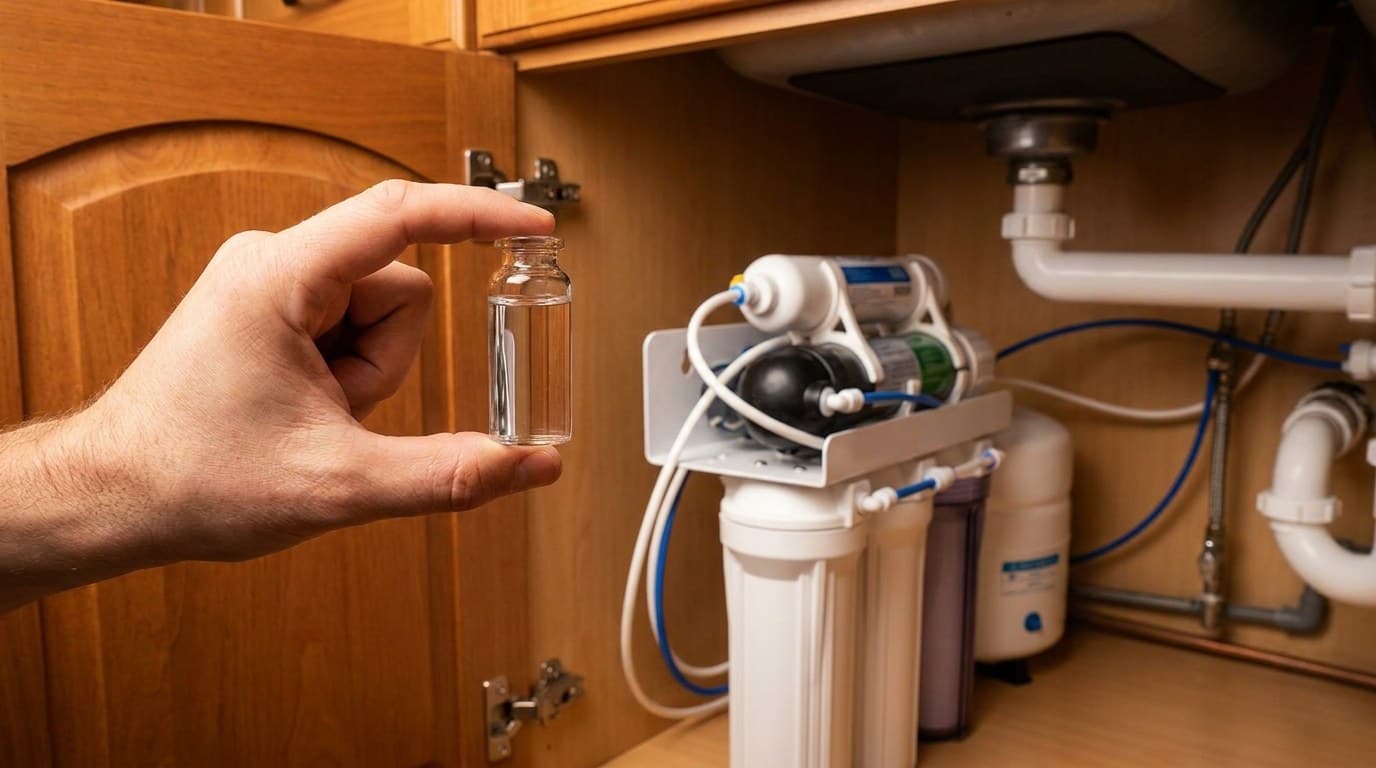
- NSF/ANSI Standard 58 (reverse osmosis). RO membranes certified under Standard 58 for PFOA and PFOS reduction consistently achieve 90 percent or greater removal in independent testing. An under-sink RO system treats water at the kitchen tap (drinking and cooking). The membrane rejects PFAS along with other dissolved solids, including nitrate, arsenic, chromium-6, and TDS. Membranes require replacement every 2 to 3 years under normal residential use.
- NSF/ANSI Standard 53 (activated carbon block). Certain activated carbon block filters certified under Standard 53 claim PFAS reduction, but performance varies by compound, contact time, and flow rate. Granular activated carbon (GAC) filters at normal residential flow rates are less effective than solid carbon block at capturing short-chain PFAS. If a carbon filter is your chosen option, verify that the specific product carries NSF 53 certification listing PFAS on its performance data sheet, not just a general claim.
- Strong-base anion exchange resin (specialized). Ion exchange resins designed specifically for PFAS removal (PFAS-selective resins) are used at the utility scale and in some high-capacity residential and commercial systems. These are not the same as a standard softener resin. If a whole-home filtration system with PFAS treatment is under consideration, confirm that the resin is PFAS-specific and that the product carries Water Quality Association (WQA) or NSF certification for PFAS reduction.
What does not remove PFAS:
- Standard cation-exchange water softeners (designed for hardness, not PFAS)
- Sediment filters (remove particles only, not dissolved PFAS)
- Standard chlorination or UV treatment (does not degrade PFAS)
- Boiling water (concentrates PFAS rather than removing it)
Many Southern California homes need both a water softener for the region's hard water and a separate point-of-use RO or certified carbon system for PFAS and other dissolved contaminants. The two systems treat different problems and are routinely installed together. Check your ZIP code to see what utility data shows for your address, or book a free in-home test to get actual readings from your tap.
How does PFAS fit alongside other Southern California water quality concerns?
PFAS is one of several contaminants of concern in Southern California water. The region's other documented issues include extremely hard water (18 to 36 grains per gallon depending on county and source blend), hexavalent chromium above California's public health goal in most LADWP service areas, legacy perchlorate contamination in Riverside County groundwater from aerospace-era rocket fuel, and arsenic in San Bernardino County high-desert wells.
An under-sink reverse osmosis system addresses several of these simultaneously: it reduces PFOA and PFOS (when NSF 58 certified), hexavalent chromium (when NSF 58 certified for chromium-6 reduction), arsenic, nitrate, and total dissolved solids. A whole-home water softener handles the hard water. Together they cover the primary water quality concerns that published utility data and state monitoring identify as most relevant for SoCal residential properties.
Because PFAS levels vary by utility, well depth, and proximity to contamination sources, the appropriate treatment depends on what your specific water shows. A certified laboratory test quantifies PFAS at your tap before any system decision is made.
Related guides and service pages
This guide covers PFAS specifically. The pages below cover related contaminants, service areas, and treatment systems.
Common questions about PFAS in Southern California water
Detectable PFAS has been found in multiple Southern California water systems, according to California State Water Resources Control Board monitoring data published under AB 756 (2020) and EPA UCMR 5 results. Military bases in San Diego, Riverside, and San Bernardino counties used PFAS-containing firefighting foam for decades, and the resulting groundwater contamination is documented in DoD environmental investigations. Whether PFAS is in your specific utility supply depends on which groundwater basins and source blends your utility draws from. Your utility's Consumer Confidence Report or the California State Water Board's drinking water data portal will show the most current readings.
The EPA published the National Primary Drinking Water Regulation for PFAS on April 10, 2024. The rule sets a maximum contaminant level of 4 parts per trillion (ppt) each for PFOA and PFOS, and 10 ppt each for PFHxS, PFNA, and HFPO-DA (GenX chemicals). Water utilities are required to test, notify customers, and comply by April 26, 2029. The full regulation is at epa.gov/sdwa/and-polyfluoroalkyl-substances-pfas.
Yes, for PFOA and PFOS, the two most studied PFAS compounds. NSF International certifies reverse osmosis systems under NSF/ANSI Standard 58 for reduction of PFOA and PFOS. In independent testing, certified RO membranes typically reduce PFOA and PFOS by 90 percent or more from the feedwater. Granular activated carbon at normal residential contact times is less consistent. If PFAS reduction is a priority, look for NSF/ANSI 58 or 53 certification specifically listing PFAS on the product documentation.
Based on publicly available DoD environmental investigations and California State Water Board records, Riverside County (near March Air Reserve Base), San Diego County (near Camp Pendleton and Miramar), and San Bernardino County (near Edwards AFB and George AFB legacy sites) have documented PFAS plumes from historic firefighting foam use. Urban areas near industrial laundry facilities, chrome plating operations, or landfills may also have elevated PFAS in localized groundwater. Confirm with your utility's Consumer Confidence Report and the State Water Board data portal at waterboards.ca.gov.
PFAS (per- and polyfluoroalkyl substances) is the broad category name for thousands of synthetic fluorinated compounds. PFOA (perfluorooctanoic acid) and PFOS (perfluorooctane sulfonic acid) are two specific long-chain PFAS compounds that have been studied most extensively and are now regulated under the EPA April 2024 rule. Both are persistent in the environment and in the human body, which is why the group earned the name forever chemicals.
No. Standard cation-exchange water softeners are designed to remove calcium and magnesium hardness ions through ion exchange. PFAS compounds are not removed by this process. PFAS removal requires either an activated carbon block filter with sufficient contact time (NSF 53 certified for PFAS), a reverse osmosis membrane (NSF 58 certified for PFOA and PFOS), or a specialized ion exchange resin designed for PFAS. A water softener and PFAS treatment serve different purposes and are often installed together in SoCal homes that have both hard water and PFAS concerns.
Find out exactly what is in your water.
A SoCal Water Treatment technician visits your home, runs a calibrated field screen for hardness, TDS, pH, and chloramine, and discusses what the utility data for your address shows. No commitment required.
Request your free water test and we will confirm a window with you directly, usually within the hour.
Know your numbers before you decide. Free test. No sales pressure. Real readings.
We test your kitchen tap with calibrated field meters for hardness, TDS, pH, and chloramine. If PFAS or other certified-lab contaminants are a concern, we walk you through how to get a certified lab test from a California-approved laboratory. You see the data before any system is discussed.
- Free water test in your kitchen. Nothing charged until you see the lab numbers.
- Three system options, all-in number, four financing terms shown side-by-side.
- 5-year comprehensive warranty. 90-day money-back guarantee.
- Same-day install in most ZIPs. Permits pulled by us.
Cleaner water at every tap by sundown. No upsell theater.
Free water test in your kitchen. Lab report in 24 hours. 5-year warranty. 90-day money-back.