Hard Water in Southern California: A County-by-County Hardness Guide
USGS maps and 2023 Consumer Confidence Reports from seven county utilities show that most SoCal households receive hard to very hard water. Here is what the numbers look like region by region, what hard water does to your home, and which treatment options the evidence supports.
Most Southern California homes receive hard water. The water is hard because of where it comes from. About half of the region's supply is imported from the Colorado River. That river picks up dissolved minerals as it flows through limestone and gypsum rock formations. Local groundwater in the Inland Empire and San Gabriel Valley has also passed through mineral-rich sediment for decades. The result is water that ranges from hard to very hard across all seven Southern California counties. Hard water is safe to drink. It does not pose a health risk. But it does form scale inside water heaters, pipes, and appliances. Scale reduces efficiency and shortens equipment life. This guide shows hardness levels for each county, explains what hard water does to your home, and compares the treatment options that remove or condition hardness minerals. All data in this guide comes from 2023 Consumer Confidence Reports filed with the California State Water Resources Control Board, the Metropolitan Water District Annual Water Quality Report, and USGS hardness monitoring records.
How we compiled this data
This guide uses three public sources. First, USGS hardness records from the National Water Information System . Second, the Metropolitan Water District Annual Water Quality Report for import water data. Third, 2023 Consumer Confidence Reports from the California SWRCB . Each water system files a CCR each year. The CCR must include hardness levels. The ranges in the table below show the full span across monitoring sites in each county, not a single reading.
Water hardness by county in Southern California
The USGS national hardness map classifies nearly all of Southern California as hard or very hard water. The WQA defines soft water as below 60 mg/L, moderately hard as 60 to 120 mg/L, hard as 120 to 180 mg/L, and very hard as above 180 mg/L. Nearly every SoCal utility falls in the hard or very hard range.
| County / Utility | mg/L as CaCO3 | GPG | Classification | Primary source |
|---|---|---|---|---|
| Los Angeles County (LADWP service area) | 227 to 297 | 13 to 17 | Hard to very hard | LADWP 2023 Consumer Confidence Report |
| Orange County (MWDOC/OCWD blend) | 200 to 280 | 12 to 16 | Hard to very hard | OCWD 2023 Water Quality Report; MWDOC member agency CCRs |
| San Diego County (MWD import dominant) | 150 to 270 | 9 to 16 | Hard to very hard | City of San Diego 2023 Water Quality Report; Carlsbad and Encinitas utility CCRs |
| Riverside County (groundwater zones) | 300 to 550 | 18 to 32 | Very hard | SWRCB SDWIS database 2023; Eastern Municipal Water District CCR |
| San Bernardino County (Inland Empire) | 300 to 500 | 18 to 29 | Very hard | SBVMWD 2023 CCR; Cucamonga Valley Water District 2023 CCR |
| Ventura County (MWD import + local wells) | 150 to 300 | 9 to 18 | Hard to very hard | Calleguas MWD 2023 Water Quality Report; City of Oxnard 2023 CCR |
| Imperial County (Colorado River direct) | 280 to 330 | 16 to 19 | Very hard | Imperial Irrigation District 2023 CCR; Colorado River at Imperial Dam USGS gauge data |
Why the Inland Empire and Imperial Valley rank highest
Riverside and San Bernardino counties rely heavily on local groundwater. That water has moved through mineral-rich rock for years, picking up calcium along the way. The Eastern Municipal Water District 2023 report recorded hardness at some wells as high as 480 mg/L, which is very hard by any standard. Imperial County gets most of its water directly from the Colorado River with little dilution. The USGS gauge at Imperial Dam records average hardness near 290 to 330 mg/L.
Los Angeles and Orange County: high but blended
LADWP mixes Colorado River water with State Water Project supply. State Project water is softer, around 100 to 130 mg/L, which lowers the final hardness a bit. The LADWP 2023 report showed distributed hardness from 227 to 297 mg/L across service zones. Most LA households fall in the hard to very hard range. Orange County groundwater runs between 200 and 280 mg/L. The exact level varies by zone depending on the blend of imported and local water.
What hard water costs homeowners
Hard water damage is real and measurable. A 2009 Battelle Memorial Institute study tested water heaters on water from soft to very hard. At the hardest level, a tank water heater lost up to 29 percent of its efficiency from scale on the heating element. Tankless heaters showed similar wear within two years. Showerhead flow dropped by up to 75 percent over 18 months. Washing machines used more energy at high hardness levels.
Soap and detergent work less well in hard water. The European Regional Development Fund Laundry Performance study found that softened water cleaned clothes just as well at lower temperatures. This cut laundry energy use by about 18 percent compared to washing in hard water.
Treatment options: what the evidence supports
Salt-based ion exchange softeners
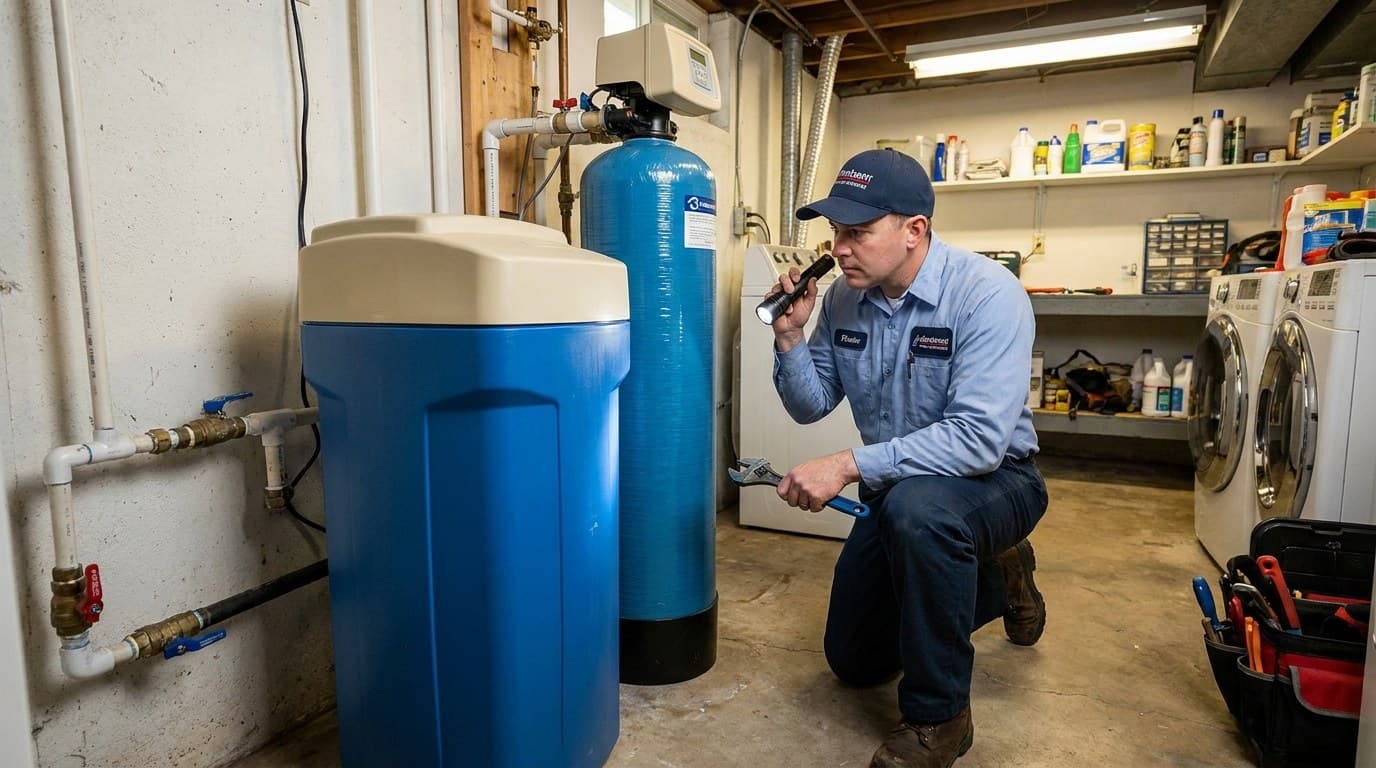
Salt-based softeners swap calcium and magnesium for sodium through a resin bed. The treated water comes out soft, typically below 1 grain per gallon. Systems certified to NSF/ANSI 44 have verified hardness reduction. Newer demand-initiated systems regenerate only when needed. This uses less salt and water than older timer-based systems. Check brine discharge rules in your area before you install (see FAQ below).
For homes with very hard water in the Inland Empire or Imperial Valley, a whole-home water softener is often the most cost-effective way to protect water heaters and appliances.
Salt-free TAC conditioners
TAC conditioners do not remove hardness minerals. They change the form of calcium and magnesium so the minerals pass through pipes without sticking. Scale does not form on heating surfaces. Performance is certified under NSF P449. TAC systems are a good choice in areas that restrict brine discharge. They add no sodium to the water and need no salt or regeneration water.
Reverse osmosis (under-sink)
RO filters remove dissolved solids from drinking water at the tap. Systems certified to NSF/ANSI 58 remove 90 to 99 percent of TDS. RO treats water at one tap. It does not protect pipes and appliances. Most homes pair an RO filter with a whole-home softener or TAC conditioner. See our TDS guide to compare RO, softeners, and carbon filters side by side.
Hard water, TDS, and other SoCal contaminants
Hardness and TDS often go up together in SoCal water. Both come from dissolved minerals in the same rock formations. High-hardness areas in the Inland Empire and Imperial Valley also tend to have higher TDS, fluoride, and sometimes nitrates from farm runoff. See our nitrates guide for details. A softener plus an under-sink RO for drinking water covers the widest range of these contaminants.
If your home is on a private well in Riverside or San Bernardino County, hardness is usually not your main concern. Chromium-6, arsenic, and nitrates may also be present and need their own treatment. A lab test from a California-certified lab is the right starting point. See our chromium-6 guide and PFAS guide for county-level data on those contaminants.
Service area coverage for water softener installation
We hold California C-55 Contractor License #1085921 and install water softeners, TAC conditioners, and combination softener-RO systems across Southern California, including Los Angeles County, Orange County, Riverside County, San Bernardino County, San Diego County, Ventura County, and Imperial County. Most installations complete in the same day. We provide a complimentary in-home water test before recommending a system.
If your home is on city water, a TAC conditioner or salt softener is often the right first step. If your home is on a well, get a lab test first. Your water may need more than just a softener. Contact us to book a free water test and get a system recommendation.
Frequently asked questions
What counts as hard water?
The Water Quality Association and USGS classify water in four levels. Soft water is below 60 mg/L. Moderately hard water is 60 to 120 mg/L. Hard water is 120 to 180 mg/L. Very hard water is above 180 mg/L. Most of Southern California falls into the hard or very hard range. This is because the region imports water from the Colorado River and draws from local groundwater, both of which carry high mineral loads.
Is hard water in Southern California safe to drink?
Yes. Water hardness itself is not a health hazard. The EPA and California DDW regulate hardness only as a secondary standard (500 mg/L TDS secondary MCL), affecting taste rather than safety. Hard water does carry elevated calcium and magnesium, which are essential minerals. The concerns with hard water are infrastructure and appliance damage, dry skin, and scale buildup, not acute health risk.
Why is Southern California water so hard?
Two factors drive hardness in SoCal water. First, the Metropolitan Water District imports roughly half of the region's supply from the Colorado River. That river flows through limestone and gypsum rock, picking up calcium and magnesium along the way. The MWD reports that Colorado River water at intake averages 270 to 290 mg/L hardness. Second, local groundwater in the Inland Empire and San Gabriel Valley has moved through mineral-rich sediment for decades. Both sources add hardness to the tap.
What does hard water actually do to your home?
Hard water leaves mineral scale inside water heaters, pipes, and appliances. A 2009 Battelle Memorial Institute study found that water heaters on very hard water lose up to 29 percent of their efficiency and fail sooner. Showerheads clog with scale. Soap does not lather as well. Glassware and fixtures get white spots. For homes with a tankless or solar water heater, scale is a serious concern because those systems are costly to repair.
Does a water softener remove all hardness?
A salt-based softener removes almost all calcium and magnesium from your water. The treated water will not form scale, lathers well, and leaves no white spots. The system needs new salt pellets every few weeks. A salt-free TAC conditioner works differently. It does not remove hardness minerals, but it changes their form so they do not stick to surfaces. A TAC system prevents scale without adding sodium to the water.
Does California restrict water softeners?
Some California communities limit or ban salt softener discharge into the sewer. High-sodium brine can harm wastewater recycling systems. The Santa Clarita Valley, Santa Barbara, and parts of the Inland Empire have had such rules. Check with your local water agency before you install a salt-based softener. High-efficiency softeners and salt-free TAC conditioners are good options in areas where brine is restricted.
Sources: USGS National Water Information System hardness records (waterdata.usgs.gov/nwis/qw); Metropolitan Water District of Southern California Annual Water Quality Report 2023 (mwdh2o.com); California State Water Resources Control Board Consumer Confidence Reports database (waterboards.ca.gov/drinking_water/certlic/drinkingwater/CCR.html); LADWP 2023 Consumer Confidence Report; OCWD 2023 Water Quality Report; Cucamonga Valley Water District 2023 CCR; Eastern Municipal Water District 2023 CCR; Imperial Irrigation District 2023 CCR; Calleguas MWD 2023 Water Quality Report; City of San Diego 2023 Annual Water Quality Report; Battelle Memorial Institute / WQRF, "Water Softening and Conditioning Effects on Water Heater Operation," 2009 (wqrf.org/research); NSF/ANSI 44 (ion exchange softeners), NSF/ANSI P449 (salt-free conditioners), NSF/ANSI 58 (reverse osmosis).
Find out how hard your water actually is
We provide a complimentary in-home water test with independent lab results. No pressure, no obligation -- just accurate numbers for your address.
- Free water test in your kitchen. Nothing charged until you see the lab numbers.
- Three system options, all-in number, four financing terms shown side-by-side.
- 5-year comprehensive warranty. 90-day money-back guarantee.
- Same-day install in most ZIPs. Permits pulled by us.
Cleaner water at every tap by sundown. No upsell theater.
Free water test in your kitchen. Lab report in 24 hours. 5-year warranty. 90-day money-back.