Total Dissolved Solids (TDS) in Southern California Water.
MWD Colorado River supply averages around 700 mg/L. Inland Empire wells regularly exceed 600 mg/L. Here is what that means and which treatment options actually reduce it.
Total Dissolved Solids (TDS) measures the combined concentration of all dissolved minerals, salts, and metals in water, expressed in milligrams per liter. The EPA sets a Secondary Maximum Contaminant Level of 500 mg/L based on taste; California enforces that same threshold as an enforceable Maximum Contaminant Level. In Southern California, TDS levels vary sharply by source. The Metropolitan Water District's Colorado River supply averages roughly 700 mg/L, while its State Water Project supply averages around 230 mg/L. Groundwater wells in the Inland Empire frequently measure 600 to 1,200 mg/L. Imperial Valley homeowners drawing from undiluted Colorado River sources face some of the highest TDS readings in the state, routinely between 700 and 900 mg/L. High TDS does not indicate an acute health risk in most cases, but it signals elevated concentrations of hardness minerals, sodium, nitrates, and other dissolved constituents. Reverse osmosis systems certified to NSF/ANSI 58 remove 90 to 99 percent of dissolved solids at the point of use.
Published: September 12, 2026. Data sources: Metropolitan Water District Annual Water Quality Report 2023; 2023 Consumer Confidence Reports filed with the California State Water Resources Control Board.
What is TDS and why does it matter in Southern California?
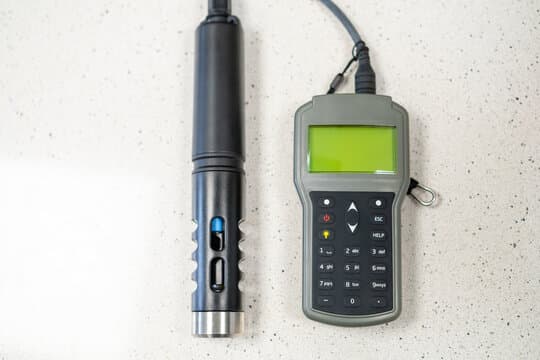
TDS is a single number that represents the sum of all dissolved inorganic and organic substances in water, including calcium, magnesium, sodium, potassium, bicarbonates, sulfates, chlorides, and trace metals. A TDS meter measures electrical conductivity and converts it to an estimated mg/L concentration; it does not identify individual constituents.
A high TDS reading matters for several practical reasons. First, it is a proxy for hardness, and Southern California water is notably hard. High hardness leaves scale on fixtures, inside water heaters, and on dishwasher elements, shortening appliance life. Second, TDS above 600 mg/L is associated with a distinctly mineral or salty taste that many people notice. Third, TDS in groundwater can reflect the presence of specific regulated contaminants such as nitrates, perchlorate, or arsenic, though TDS alone cannot confirm or rule out any specific contaminant.
Southern California is a high-TDS region by design. Metropolitan Water District imports Colorado River water that has been concentrated by evaporation and mineral dissolution across 1,400 miles of river channel originating in the Rockies. That water blends with local groundwater in the distribution system, producing the wide regional variation visible in the table below.
Federal and California TDS standards
The EPA established 500 mg/L as the Secondary Maximum Contaminant Level for TDS under the Safe Drinking Water Act. Secondary standards address aesthetic qualities, not health risk, and are not federally enforceable against public water systems. California is different. The California State Water Resources Control Board incorporates TDS into its primary regulatory framework under Title 22 of the California Code of Regulations, setting 500 mg/L as an enforceable primary MCL for most sources, with an alternate 1,000 mg/L limit available for specific well sources when no better supply is reasonably available.
Sources: EPA Secondary Drinking Water Standards (2023); California Code of Regulations Title 22; World Health Organization Guidelines for Drinking Water Quality, 4th edition.
TDS by region in Southern California: what 2023 utility data shows
The ranges below are compiled from 2023 Consumer Confidence Reports submitted to the California State Water Resources Control Board Division of Drinking Water, plus Metropolitan Water District annual water quality data. Groundwater-supplied regions show the highest variability because TDS fluctuates by well depth, basin geology, and seasonal recharge. Your utility's specific CCR lists exact measured values for the water reaching your tap.
| Region | Typical TDS (mg/L) | Primary Source | MCL Status | Reference |
|---|---|---|---|---|
| Los Angeles (LADWP) | 250 to 600 | Imported blend + local groundwater | Below CA MCL | LADWP 2023 Consumer Confidence Report |
| Orange County (OCWD blend) | 280 to 550 | Imported (MWD) + recycled + groundwater | Below CA MCL | OCWD 2023 Water Quality Report |
| Inland Empire (groundwater wells) | 400 to 1,200 | Local groundwater | Some wells above CA MCL | Inland Empire Utilities Agency 2023 CCR |
| San Diego County | 350 to 700 | Colorado River (SDCWA) + State Project | Below CA MCL | SDCWA 2023 Water Quality Report |
| Ventura County | 200 to 500 | State Water Project + local | Below CA MCL | Ventura County Waterworks 2023 CCR |
| Imperial Valley | 700 to 900 | Colorado River (undiluted) | Approaches CA MCL | Imperial Irrigation District 2023 Consumer Confidence Report |
Ranges reflect blended treated water at the distribution system entry point. Individual tap readings may vary by neighborhood, building plumbing, and seasonal source blend. Data compiled from 2023 Consumer Confidence Reports and MWD Annual Water Quality Report 2023.
Get a free in-home water test with independent lab verification. Results in 24 hours. No commitment.
A SoCal Water Treatment technician measures TDS and identifies specific dissolved constituents at your tap, then sends a sample to a certified independent lab. You see the exact numbers before you see a quote. License: CA C-55 #1085921.
- Free water test in your kitchen. Nothing charged until you see the lab numbers.
- Three system options, all-in number, four financing terms shown side-by-side.
- 5-year comprehensive warranty. 90-day money-back guarantee.
- Same-day install in most ZIPs. Permits pulled by us.
Is high TDS water harmful to drink?
TDS itself is not a direct health indicator. Water with 800 mg/L TDS composed primarily of calcium and magnesium bicarbonates is not harmful and is in fact common in mineral waters sold at grocery stores. Water with the same 800 mg/L TDS composed partly of sodium chloride, nitrates, or trace heavy metals presents a different picture. That is why TDS is best understood as a screening signal, not a verdict.
For most Southern California households on public water supplies, TDS at the levels reported in utility CCRs reflects hardness minerals rather than toxic constituents. The water meets all California health-based MCLs. The practical concerns are aesthetic (taste, odor, scale) rather than acute health risk.
The exception is private well water in the Inland Empire, Riverside County, and Imperial County. Wells in those areas can draw from deep aquifers with elevated TDS that may include elevated nitrates, naturally occurring arsenic, or chromium-6. Private well owners are not covered by the public water system monitoring requirements and should test at a state-certified lab annually. A high TDS reading from a well is a prompt to investigate the composition, not just treat the number.
Water above 600 mg/L frequently tastes mineral, salty, or bitter. The primary drinking water complaint in high-TDS areas like the Inland Empire and Imperial Valley is flat or heavy-tasting water. Reverse osmosis removes the dissolved solids responsible for this character, producing water that tastes close to distilled.
The hardness component of TDS (calcium and magnesium) precipitates as scale when water is heated, coating water heater elements, dishwasher spray arms, and coffee makers. This reduces efficiency, raises energy consumption, and shortens appliance life. A water softener addresses hardness; an RO system addresses both hardness and the full TDS load.
Some pediatricians recommend low-TDS water for mixing infant formula in high-TDS regions, as infants consume proportionally more water relative to body weight than adults. Consult your pediatrician. An NSF/ANSI 58 certified RO system produces water suitable for formula preparation.
Which water treatment technologies reduce TDS?
TDS reduction requires membrane or distillation technology. Filters that work by adsorption (activated carbon) or mechanical straining (sediment cartridges) do not remove dissolved mineral salts, because dissolved ions are too small to be caught by any porous media. Ion exchange water softeners remove calcium and magnesium specifically but replace them with sodium, leaving overall TDS roughly unchanged.
| Technology | TDS Removed | NSF Standard | Notes |
|---|---|---|---|
| Reverse osmosis (under-sink) | 90 to 99% | NSF/ANSI 58 | Best for drinking and cooking water; treats the kitchen tap only. |
| Whole-house RO | 90 to 99% | NSF/ANSI 58 | Treats the entire home; requires larger membrane arrays and a storage tank. |
| Distillation | 99%+ | NSF/ANSI 10 | Produces near-zero TDS water; slow throughput and high energy use. |
| Activated carbon filter | Less than 5% | NSF/ANSI 42 | Removes chlorine, taste, and odor. Does not reduce dissolved mineral salts. |
| Water softener (ion exchange) | 0 to 5% net | NSF/ANSI 44 | Removes hardness ions but replaces them with sodium; TDS may rise slightly. |
| Sediment filter | 0% | NSF/ANSI 42 | Removes particulates only. No effect on dissolved solids. |
Removal rates from WQA Technical Application Bulletins and NSF International testing protocols. Actual performance varies by feed water composition, membrane age, and system maintenance.
For most SoCal households, an under-sink reverse osmosis system paired with a whole-house water softener addresses both the scale problem (softener removes hardness from all taps and appliances) and the drinking water quality concern (RO removes 90 to 99% of all dissolved solids at the kitchen tap). For well owners in high-TDS areas like Riverside County or Imperial Valley, a whole-house RO system with a large pre-filter and storage tank is the more complete solution, though it requires professional sizing and CA C-55 licensed installation.
For help sizing an RO or softener system to your specific TDS reading, call (949) 873-1129 or book a free water test. Our technicians bring calibrated TDS meters and test at the tap before recommending equipment. License: CA C-55 #1085921.
How to test your Southern California tap water for TDS
There are two paths depending on how much detail you need. A consumer-grade TDS meter gives you a single combined reading in about 30 seconds. It costs under $20 at any hardware store. Fill a clean glass with tap water, insert the probe, wait for the reading to stabilize, and note the result in mg/L. This tells you the total dissolved solids load but nothing about which constituents make it up.
For a full picture, especially on a private well, a certified lab test identifies specific ions and regulated contaminants. The California State Water Resources Control Board maintains a list of certified drinking water laboratories that test for the full suite of California MCL parameters. Southern California Water Treatment provides complimentary in-home testing, including TDS measurement plus a sample sent to an independent certified lab, at no cost or obligation.
You can also check your utility's most recent Consumer Confidence Report on the SWRCB Division of Drinking Water portal or request a printed copy from your utility directly. CCRs are published annually by every public water system in California and include TDS readings alongside all regulated contaminant test results. Our water quality reports page links directly to CCRs for the largest utilities across Southern California service areas.
Frequently asked questions
What TDS level is safe in drinking water?
The EPA Secondary Maximum Contaminant Level for TDS is 500 mg/L, enforced by California as a primary MCL. Water below that level meets regulatory standards. The World Health Organization notes that water below 300 mg/L tastes excellent and water above 600 mg/L often tastes unpleasant. High TDS does not automatically mean the water is unsafe.
Why is TDS so high in Southern California?
Two factors drive SoCal TDS: imported Colorado River water naturally carries dissolved minerals from the Rocky Mountain watershed, typically 650 to 750 mg/L at the Imperial Dam. Local groundwater in the Inland Empire and San Gabriel Valley has absorbed additional minerals as it percolated through sedimentary formations over decades, producing some of the highest TDS readings in the state.
Does a water softener lower TDS?
A salt-based water softener removes calcium and magnesium ions from water, replacing them with sodium ions. Because sodium is itself a dissolved solid, a softener may slightly raise or leave TDS unchanged while eliminating scale-causing hardness. To actually reduce TDS, reverse osmosis is the appropriate technology. Many homeowners combine a whole house softener with an under-sink RO system.
How do I test TDS in my tap water?
A digital TDS meter costs under $20 and gives a reading in seconds. Insert the probe, wait for the reading to stabilize, and read in mg/L or ppm. For a full picture, a professional water test from a state-certified lab identifies which specific dissolved constituents are present, not just the combined total. We provide complimentary in-home testing with independent lab results.
Does boiling water reduce TDS?
No. Boiling water kills microbial contaminants but concentrates dissolved solids because pure water evaporates while minerals remain. A boiled cup of high-TDS water has higher TDS than before boiling. Reverse osmosis, distillation, and deionization are the methods that actually reduce dissolved solid concentration.
What TDS level does reverse osmosis produce?
A well-maintained reverse osmosis system certified to NSF/ANSI 58 reduces TDS by 90 to 99 percent. Starting from 700 mg/L Colorado River blended water, the permeate from a four-stage RO system typically reads 10 to 70 mg/L at the tap, comfortably below the EPA secondary standard and the WHO excellent-taste threshold of 300 mg/L.
Cleaner water at every tap by sundown. No upsell theater.
Free water test in your kitchen. Lab report in 24 hours. 5-year warranty. 90-day money-back.