Lead in Southern California drinking water.
The EPA tightened its lead rules in October 2024, cutting the action level from 15 to 10 ppb and requiring every utility to inventory and replace lead service lines within 10 years. Here is what SoCal utility data shows and what in-home plumbing risk looks like by construction era.
Lead does not occur naturally in Southern California's water sources. It enters tap water through contact with lead-containing plumbing materials, most commonly lead solder used in home construction before 1986 and, in older neighborhoods, lead service lines connecting the street main to the house. The EPA finalized the Lead and Copper Rule Improvements (LCRI) on October 8, 2024, lowering the federal action level from 15 parts per billion to 10 parts per billion and requiring utilities to complete verified lead service line inventories and replace all lead service lines within 10 years. Major SoCal utilities including LADWP, Burbank Water and Power, and San Diego Public Utilities have reported 90th percentile tap results well below those thresholds in their Consumer Confidence Reports. The primary risk for most SoCal homeowners is in-home plumbing in pre-1986 construction, not the utility main. A certified laboratory test of first-draw water confirms actual exposure at your tap.
Cleaner water at every tap by sundown. No upsell theater.
Free water test in your kitchen. Lab report in 24 hours. 5-year warranty. 90-day money-back.

What did the EPA's 2024 Lead and Copper Rule change?
The EPA finalized the Lead and Copper Rule Improvements (LCRI) on October 8, 2024. This rule built on the 2021 Lead and Copper Rule Revisions (LCRR) to set the strictest federal requirements for lead in drinking water since the original 1991 rule. The full rule text is available at epa.gov/sdwa/lead-and-copper-rule-revisions.
Source: EPA Lead and Copper Rule Improvements, Federal Register, October 2024
| Requirement | Before LCRI | Under LCRI (2024) |
|---|---|---|
| Lead action level (tap) | 15 ppb | 10 ppb |
| Trigger for corrosion control treatment | 10% of homes above 15 ppb | 10% of homes above 10 ppb |
| Lead service line inventory | Required since LCRR (January 2021) | Verified and updated inventory required; must be public |
| Lead service line replacement timeline | No mandatory completion deadline | Full replacement within 10 years of rule compliance date |
| Customer notification | Annual Consumer Confidence Report | Individual notification if lead service line is present at property |
| Tap testing program | Six-month stagnation protocol | First-draw sampling after standing time; broader sampling pool |
California set its own lead action level at 15 ppb under the Safe Drinking Water Act, mirroring the original federal standard. The State Water Resources Control Board maintains a lead service line inventory program launched under Assembly Bill 746 (2019). Under that program, California water systems were required to submit initial service line inventories to the state by July 2021, covering the utility-owned portion of the line from the street main to the property connection. That inventory data is published at waterboards.ca.gov/drinking_water/programs/lead.
How does lead get into Southern California tap water?
Lead does not occur naturally in the Colorado River, the Eastern Sierra Aqueduct, or the local groundwater basins that supply most Southern California homes. The Centers for Disease Control and Prevention (CDC) identifies plumbing as the primary pathway for lead in tap water at the household level (CDC, cdc.gov/niosh/topics/lead).
There are three plumbing points where lead can enter water before it reaches your glass. First, the service line: the pipe running from the utility main under the street to the water meter and into your home. Utilities own the portion from the main to the meter; homeowners typically own the portion from the meter to the house. In older SoCal neighborhoods built before 1930, some service lines were originally installed with lead pipe. Second, solder at pipe joints: homes built between approximately 1930 and 1986 used lead-tin solder to connect copper pipes at joints inside the walls. The federal Safe Drinking Water Act was amended in 1986 to ban lead in plumbing solder and new service pipes. Third, fixtures and faucets: brass fixtures manufactured before 1988 commonly contained lead alloys. The designation “lead-free” now requires less than 0.25 percent lead by weighted average in wetted surfaces under federal law.
Lead leaches into water through corrosion. Soft water (low pH, low mineral content) is more corrosive than hard water. Southern California's tap water is generally hard, which provides some natural corrosion resistance at pipe surfaces. Utilities also add corrosion inhibitors such as orthophosphate to reduce leaching from in-home plumbing. However, corrosion inhibitors do not eliminate lead from older fixtures or heavy-use solder joints. Water that has sat overnight in pipes (stagnant water) consistently shows higher lead readings than water flushed directly from the main.
Which Southern California homes face the highest lead risk?
Construction era is the single most reliable predictor of in-home lead risk in Southern California. The table below maps construction period to plumbing risk based on when key materials were phased out under federal and California law.
| Construction era | In-home plumbing risk | Primary concern |
|---|---|---|
| Pre-1930 | High | Lead service lines and lead pipe common in residential plumbing of that era |
| 1930 to 1950 | Moderate to high | Lead solder at joints likely; some lead service lines in older SoCal neighborhoods |
| 1950 to 1986 | Moderate | Copper pipe common but lead-tin solder widely used until 1986 federal ban |
| 1986 to 1988 | Low to moderate | Lead solder banned in plumbing (Safe Drinking Water Act Amendment 1986); brass fixtures may still contain lead alloys |
| Post-1988 | Low | Lead-free plumbing materials required; very low risk from in-home plumbing. Fixture quality still varies. |
SoCal cities with the highest share of pre-1960 housing stock include older sections of Los Angeles (Boyle Heights, Highland Park, Silver Lake, Leimert Park), Pasadena, Long Beach, and downtown San Diego. Newer Inland Empire cities such as Temecula, Corona, and Rancho Cucamonga built out their residential stock primarily after 1980 and carry lower in-home lead risk from plumbing. Orange County's post-war suburban development means most homes there fall in the 1950 to 1986 moderate risk category.
One frequently overlooked source: rental units where original plumbing has never been updated. A 1960s apartment complex in Burbank or the San Fernando Valley may have undergone cosmetic renovation while the original solder joints remain. Tenants in pre-1986 construction should consider a point-of-use filter regardless of what the building looks like from the outside.
What do SoCal utility Consumer Confidence Reports show about lead?
Every regulated water utility must publish an annual Consumer Confidence Report (CCR) disclosing lead results from its tap-water monitoring program. The EPA requires utilities to sample tap water at residences considered most at risk (older homes, those with service line connections of unknown material) and report the 90th percentile result. The 90th percentile means 90 percent of sampled taps tested below that level.
Major SoCal distributors have reported 90th percentile tap lead results well below the former 15 ppb action level in recent CCRs. LADWP's 2023 Consumer Confidence Report (available at ladwp.com) shows 90th percentile lead at 3 ppb across sampled service areas. The City of Burbank Water and Power CCR and San Diego Public Utilities CCR (both published annually and available on their utility websites) similarly report 90th percentile tap levels in the 1 to 5 ppb range in recent reporting years.
These utility averages mask individual variation. A single pre-1960 home with original solder joints and first-draw sampling (water sitting overnight in the pipes) can test significantly above the utility average even when the utility's 90th percentile is low. If you live in pre-1986 construction and have not tested your tap, the utility CCR average should not be interpreted as confirmation that your specific tap is safe.
To find your utility's most recent CCR, search the EPA's Consumer Confidence Report database at epa.gov/ccr, or search your utility name plus “Consumer Confidence Report” or “water quality report.” California utilities also file reports with the State Water Board at waterboards.ca.gov.
How do you test for lead at your tap?
The only way to know your actual tap lead level is a certified laboratory test. In-home test kits sold at hardware stores do not provide laboratory-grade accuracy. A proper test uses the following protocol recommended by EPA and the California State Water Board.
- Do not use the tap for at least six hours before sampling so water stagnates in the pipes. Overnight is ideal.
- Collect a first-draw sample: the very first water that comes out of the faucet without flushing. Use a clean one-liter bottle provided by the laboratory.
- Collect a second sample after 30 seconds of flushing to represent water from the service line rather than in-home plumbing.
- Submit both samples to a California-certified laboratory. Results typically arrive in 5 to 10 business days. The State Water Board maintains a certified lab directory at waterboards.ca.gov.
Laboratory testing typically costs $30 to $80 per sample through a certified California lab. Some utilities offer free lead test kits to customers in older homes. Contact your utility's customer service line to ask if this program is available in your service area. Results above 10 ppb (the new LCRI action level) or above California's action level warrant consultation with a licensed plumber and installation of a certified filter while the plumbing source is addressed.
Which water filters remove lead in Southern California homes?
NSF International certifies water treatment units against specific contaminant reduction standards. For lead removal, look for certification under the following standards (NSF certification database is searchable at nsf.org).
NSF/ANSI 53
Health effects reduction standard. Covers point-of-use filters (pitcher, faucet-mount, under-sink). A filter certified under NSF 53 specifically for lead must list lead in its certification documentation. Commonly found in carbon block under-sink units and activated carbon faucet filters. Appropriate for drinking and cooking water at a single tap. For whole-home application in pre-1986 construction, a whole-home cartridge system certified under NSF 53 for lead can be installed at the main.
NSF/ANSI 58
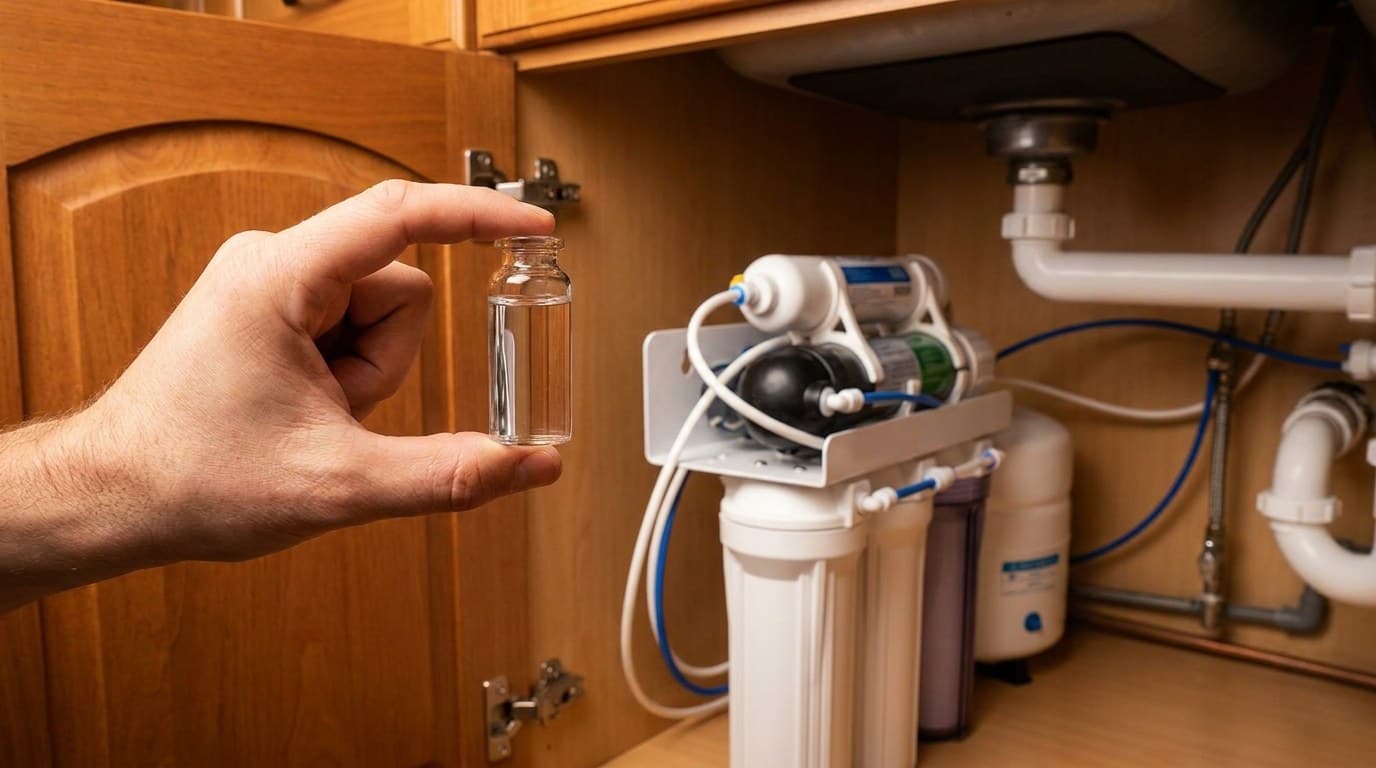
Reverse osmosis standard. RO systems certified under NSF 58 and listed for lead reduction are among the most effective residential treatment options for lead, typically achieving more than 95 percent reduction of lead from the feedwater. Point-of-use RO units under the kitchen sink treat drinking and cooking water. Whole-home RO is expensive and not typically necessary for lead alone; point-of-use RO is the appropriate solution when the concern is in-home plumbing leaching or high utility tap results.
Note that a water softener alone does not remove lead. Standard cation exchange softeners remove calcium and magnesium, not heavy metals. If you have both hard water and lead concerns, which is common in pre-1986 SoCal homes on imported Colorado River water, the appropriate combination is a whole-home softener for hardness plus a point-of-use NSF 53 or NSF 58 certified unit for the kitchen tap. An in-home water assessment will confirm which combination is right for your water.
Southern California homes dealing with multiple contaminants, whether chromium-6, PFAS, nitrate, or lead, often find that a reverse osmosis system at the kitchen tap handles the full profile of regulated contaminants in a single certified unit. The whole-home water softener then addresses scale, soap efficiency, and appliance longevity separately.
What should Southern California homeowners do about lead?
The practical steps depend on your home's age and your most recent tap test result.
Post-1988 construction
Low risk. Confirm that your service line material is known through your utility's lead service line inventory. If the utility lists your service line as unknown material, request clarification. No immediate filter installation is required, but an annual flush practice (run cold water 30 seconds before first draw each morning) is a simple precaution.
1950 to 1986 construction
Moderate risk. Consider a certified laboratory test ($30 to $80) using the first-draw sampling method. If the result is at or above 5 ppb, install a point-of-use filter certified under NSF 53 or NSF 58 for lead at the kitchen tap. Have a licensed plumber identify whether original solder joints are at high flow-restriction bends or branch points, which accelerate corrosion.
Pre-1950 construction
Higher risk. Test immediately with a first-draw certified lab sample. Install a certified filter before results arrive if you have children under 6 or are pregnant. The CDC states there is no safe blood lead level in children (CDC, cdc.gov/niosh/topics/lead). If the first-draw result exceeds 10 ppb, contact your utility to determine whether the service line is a lead-containing material and request corrosion control documentation. Have a plumber inspect in-home solder joints.
If you are on a private well in a rural Riverside County, San Bernardino, or Ventura County property, you are not covered by the EPA Lead and Copper Rule. Well water is not tested by a utility and you bear full responsibility for testing and treatment. Annual testing by a California-certified lab is the standard recommendation for private wells. Our whole-home filtration assessment covers private well clients across the Riverside, San Bernardino, and Ventura County service areas.
Frequently asked questions about lead in SoCal water
Is there lead in Southern California tap water?
Southern California utilities regulated under the Safe Drinking Water Act report 90th percentile lead levels at the tap in their annual Consumer Confidence Reports. Major distributors including LADWP, Burbank Water and Power, and San Diego Public Utilities have historically reported 90th percentile tap results well below the former 15 ppb action level and below the new 10 ppb standard finalized in the 2024 Lead and Copper Rule Improvements. The greater risk in SoCal is not the utility main but in-home plumbing: homes built before 1986 may contain lead solder at pipe joints, and pre-1988 brass fixtures can leach lead regardless of the service line material.
What is the new EPA action level for lead in drinking water?
The EPA finalized the Lead and Copper Rule Improvements (LCRI) on October 8, 2024. The rule lowered the lead action level from 15 parts per billion to 10 parts per billion. It also requires all water utilities to complete a lead service line inventory, notify customers if their service line is lead, and replace lead service lines within 10 years. Utilities that exceed the 10 ppb action level must take immediate remediation steps. The full rule is available at epa.gov/sdwa/lead-and-copper-rule-revisions.
How do I know if my home has lead plumbing?
If your home was built before 1986, there is a meaningful chance that lead solder was used at pipe joints inside the walls, or that your original fixtures contain lead alloys. Homes built before 1930 in older SoCal neighborhoods may have lead service lines connecting the street main to the home. Your utility's lead service line inventory (required since 2021 and updated under the 2024 rule) may cover the portion of line the utility owns. For the in-home portion, contact a licensed California plumber to inspect your supply lines. A certified laboratory test of first-draw tap water after overnight stagnation is the most direct way to know what your tap delivers.
Does a reverse osmosis system remove lead from drinking water?
Yes. Reverse osmosis systems certified under NSF/ANSI Standard 58 are tested and verified to reduce lead at the tap. In independent testing, certified RO membranes typically reduce lead by more than 95 percent from the feedwater. A point-of-use RO unit installed at the kitchen sink addresses drinking and cooking water. For whole-home lead concerns tied to in-home plumbing, a whole-home filtration system certified under NSF/ANSI 53 for lead reduction is the appropriate solution.
Does a water softener remove lead?
No. A standard cation-exchange water softener is designed to remove calcium and magnesium hardness and does not reliably remove lead. Some ion exchange resins can be configured to capture heavy metals including lead, but standard residential water softeners sold for scale prevention are not certified for lead reduction. For lead, use an NSF/ANSI 53-certified filter or NSF/ANSI 58-certified reverse osmosis system in addition to your softener.
What should I do if my tap water tests above 10 ppb for lead?
First, stop using the tap for drinking and cooking until the source is identified and addressed. Flush the tap for 30 to 60 seconds before using water for any purpose, since lead concentrates during stagnation. Contact your utility to determine whether the service line from the street to your home is lead-containing. If the utility's line is clear, have a licensed plumber inspect your in-home plumbing, joints, and fixtures. Install a point-of-use filter certified under NSF/ANSI 53 or 58 for lead reduction while the investigation is underway. California-certified laboratory testing costs $30 to $80 per sample and provides legally defensible results.
Related guides and resources
- PFAS forever chemicals in Southern California water
- Chromium-6 in Southern California: complete guide
- Southern California water quality by county (2026)
- Reverse osmosis installation
- Whole-home filtration
- Water softener installation
- Los Angeles County water treatment
- Orange County water treatment
- San Diego County water treatment
- Riverside County water treatment
- San Bernardino County water treatment
- Ventura County water treatment
- Check your water by ZIP code
- Lead contaminant overview
- Schedule an in-home water test
Get a certified water test for your home
Our licensed technicians test for lead, hardness, chromium-6, PFAS, and total dissolved solids. Same-day appointments available across Southern California.
- Free water test in your kitchen. Nothing charged until you see the lab numbers.
- Three system options, all-in number, four financing terms shown side-by-side.
- 5-year comprehensive warranty. 90-day money-back guarantee.
- Same-day install in most ZIPs. Permits pulled by us.
Book your free water consultation
Pick a window for your free water test.
A SoCal Water Treatment tech meets you in your kitchen, runs the test, sends the lab sample. No charge, no commitment.
Request your free water test and we will confirm a window with you directly, usually within the hour.
Cleaner water at every tap by sundown. No upsell theater.
Free water test in your kitchen. Lab report in 24 hours. 5-year warranty. 90-day money-back.