
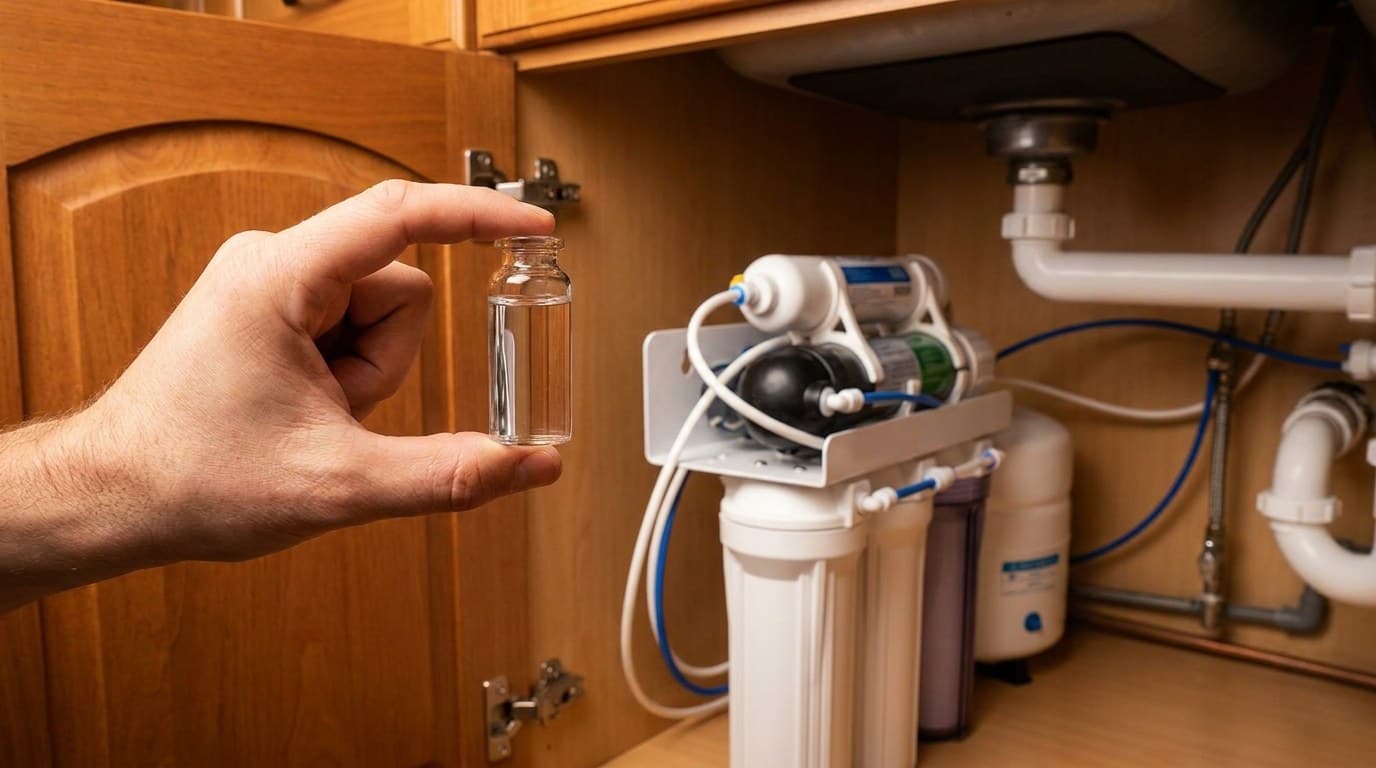
Naturally occurring arsenic is documented in groundwater across the Inland Empire, including the Coachella Valley and the San Bernardino County high desert, according to the USGS National Water Information System and the California Groundwater Ambient Monitoring and Assessment (GAMA) program. The EPA Maximum Contaminant Level for arsenic in public drinking water is 10 micrograms per liter (10 ppb). Private well owners in San Bernardino and Riverside counties are not covered by federal or state safe drinking water monitoring requirements, meaning they have no mandatory testing or treatment obligations and no regulatory visibility into their water quality. This guide explains which Inland Empire basins show the highest documented arsenic concentrations, what the health stakes are at levels above the MCL, and which NSF-certified treatment technologies reduce arsenic to safe levels for well owners in the Coachella Valley and high-desert communities.
Published August 19, 2026 · Data sourced from USGS NWIS and California GAMA · Southern California Water Treatment
Private well owners have no regulatory safety net
The federal Safe Drinking Water Act regulates public water systems serving 25 or more people. Private wells serving individual households are exempt from mandatory arsenic testing, treatment, and reporting requirements. The California State Water Resources Control Board and the EPA both note that private well owners are solely responsible for knowing what is in their water. Regular testing by an ELAP-certified California laboratory is the only way to know current arsenic levels.
Why does the Inland Empire have naturally occurring arsenic in groundwater?
Arsenic in Inland Empire groundwater is geologic in origin, not industrial. USGS Professional Paper 1703, Arsenic in Groundwater of the Western United States (pubs.usgs.gov/pp/1703), identifies three primary geologic sources for elevated arsenic in Southern California desert basins:
- Volcanic and igneous rock weathering: The San Bernardino Mountains and desert ranges flanking the Mojave and Coachella basins contain volcanic and granitic formations with naturally elevated arsenic concentrations. Groundwater percolating through these formations leaches arsenic into the aquifer over geologic time.
- Marine sedimentary deposits: Parts of the Coachella Valley aquifer contain marine sedimentary layers from when the region was a shallow sea. These layers can trap arsenic-bearing minerals that release under reducing (low-oxygen) aquifer conditions.
- Geothermal influence: The Salton Sea geothermal field and related subsurface heat in eastern Riverside County drive hydrothermal circulation that concentrates arsenic and other trace elements in groundwater. The Coachella Valley Water District (CVWD) 2023 to 2024 Consumer Confidence Reports note geothermal influence as a factor in arsenic monitoring for deep production wells.
The California GAMA program, operated by the State Water Resources Control Board, has conducted systematic groundwater quality monitoring across Inland Empire basins since 2003. GAMA data, accessible through the GAMA groundwater information system at gamagroundwater.waterboards.ca.gov, provides well-level arsenic measurements by basin and sub-basin. For Inland Empire residents, this portal is the best publicly available screening resource before commissioning formal well testing.
Which Inland Empire groundwater basins show the highest arsenic concentrations?
The table below summarizes documented arsenic presence in key Inland Empire groundwater basins, drawn from USGS NWIS monitoring records and the California GAMA data portal. Ranges reflect monitoring well data and may differ from individual private well results, which vary by well depth, construction, and local geology. Verify with current basin-specific reports and independent testing.
| Groundwater Basin | County | Documented Arsenic |
|---|---|---|
| Coachella Valley (main) | Riverside | Up to 65 ppb detected in monitoring wells |
| Mojave River (Victor Valley) | San Bernardino | Detections from 2 to 28 ppb in private well sampling |
| Warren Valley / Morongo Valley | San Bernardino | Detections above 10 ppb documented in GAMA well network |
| Lucerne Valley | San Bernardino | Background range 5 to 20 ppb in deep monitoring wells |
| Indio Subbasin (east Coachella) | Riverside | Municipal wells treated; private well risk varies |
Sources: USGS National Water Information System (waterdata.usgs.gov); California GAMA Groundwater Information System (gamagroundwater.waterboards.ca.gov); Coachella Valley Water District Consumer Confidence Reports 2023 to 2024. Data reflects monitoring well sampling, not treated finished water supplied by utilities. Private well concentrations vary by location and depth.
What are the health effects of arsenic in well water?
Inorganic arsenic is classified as a Group 1 known human carcinogen by the International Agency for Research on Cancer. The Agency for Toxic Substances and Disease Registry (ATSDR) at atsdr.cdc.gov summarizes the primary health effects associated with chronic arsenic ingestion from drinking water:
- Cancer risk: Long-term exposure above the EPA MCL of 10 ppb is associated with elevated risk of bladder, lung, and skin cancers. The EPA estimates that consuming water at 10 ppb over a lifetime poses a cancer risk of approximately 3 in 10,000, which is why the MCL was lowered from 50 ppb to 10 ppb in 2006.
- Cardiovascular effects: Chronic arsenic exposure at elevated levels is linked to hypertension and increased cardiovascular disease risk in epidemiological studies reviewed by ATSDR.
- Diabetes: The ATSDR and WHO note an association between chronic low-level arsenic ingestion and type 2 diabetes, based on studies in populations with elevated arsenic exposure in drinking water.
- Neurological effects in children: The National Institute of Environmental Health Sciences (niehs.nih.gov) identifies developing children as a particularly vulnerable population, with arsenic exposure linked to cognitive development effects at lower concentrations than those that cause adult health outcomes.
The EPA arsenic MCL of 10 ppb was set balancing feasibility and cost of treatment against risk. California OEHHA has not published a separate public health goal for arsenic in drinking water at a lower level, unlike its goals for chromium-6 and nitrates, meaning the 10 ppb standard represents the current operative limit for California regulatory purposes.
A SoCal Water Treatment technician tests your water at the tap for arsenic, hardness, total dissolved solids, and other contaminants common to Inland Empire well and municipal supplies. Independent lab results in 24 hours. No obligation.
What do Coachella Valley residents need to know about arsenic in their water?
The Coachella Valley groundwater basin is one of the more extensively studied arsenic-affected aquifers in California. The Coachella Valley Water District (CVWD), which serves roughly 100,000 residents across the valley, operates treatment infrastructure specifically to reduce arsenic in its production wells to below the EPA MCL before delivering water to the community. CVWD Consumer Confidence Reports from 2023 to 2024 document source water arsenic in select production wells at concentrations above 10 ppb before treatment, with finished delivered water meeting the MCL.
For CVWD municipal customers, treated tap water is the relevant exposure point and the utility manages compliance. The risk picture is different for:
- Private well owners in the eastern Coachella Valley: The eastern portion of the valley, including areas around Mecca, Oasis, and Thermal, has a higher proportion of private well users and less complete utility coverage. GAMA monitoring data for this sub-area documents arsenic above 10 ppb in some private wells. These residents are entirely outside regulatory monitoring requirements.
- Homes with older or shallow wells: Well depth and construction year affect arsenic exposure risk. Shallow wells drawing from older alluvial deposits may intersect arsenic-rich horizons that deeper, cased utility production wells avoid. A USGS study of California desert wells found shallower wells more likely to exceed arsenic thresholds than deep production wells in the same basin.
What is the arsenic situation for San Bernardino County high-desert communities?
San Bernardino County's high-desert communities, including Victorville, Apple Valley, Hesperia, and the more rural communities of the Mojave Desert and Victor Valley area, draw from the Mojave River groundwater basin and smaller sub-basins. The California GAMA Mojave Basin Area report (available via the GAMA portal at gamagroundwater.waterboards.ca.gov) documents arsenic in monitoring wells across the basin at concentrations ranging from background levels below 2 ppb to detections above the MCL in specific wells, particularly in alluvial fan areas at the margins of the basin where volcanic source material concentrates.
Large utilities serving Victor Valley, including the Victor Valley Water District and Victorville Water District, operate treatment and comply with EPA and California MCL requirements. Their Consumer Confidence Reports, available on request or at waterboards.ca.gov, show finished water arsenic results by monitoring period.
Rural and unincorporated areas of the high desert with a higher density of private domestic wells present the greatest unmonitored arsenic risk. The San Bernardino County Environmental Health Division recommends that private well owners test for arsenic as part of a comprehensive well water test at least every two to three years or following any well modification or nearby land use change.
What treatment options remove arsenic from Inland Empire well water?
NSF International certifies residential water treatment systems against specific contaminants under its ANSI/NSF standards. Two standard categories apply to arsenic reduction:
NSF/ANSI 58 (Reverse Osmosis)
- Point-of-use installation at kitchen sink
- Typically 85 to 95% arsenic reduction in certified testing
- Removes a broad range of other contaminants simultaneously
- Treats drinking and cooking water; not whole-house
Not all RO systems are tested for arsenic. Verify NSF/ANSI 58 certification and arsenic-specific claim at nsf.org before purchase.
NSF/ANSI 53 (Adsorption Media)
- Activated alumina or iron-based media certified for arsenic reduction
- Can be installed as point-of-use or point-of-entry (whole-house)
- Media requires periodic regeneration or replacement
- Effectiveness depends on source water pH and competing ions
Performance varies significantly by water chemistry. A water test is necessary before selecting the right media type and sizing the system.
For well water with elevated arsenic, the selection between NSF/ANSI 58 RO and NSF/ANSI 53 adsorption media depends on several factors: the arsenic concentration, whether co-contaminants (iron, silica, phosphate) are present that compete with arsenic for adsorption sites, and whether whole-house treatment or point-of-use treatment is the priority. A comprehensive water test is a prerequisite for correct system sizing and selection.
Treatment systems that are NOT certified for arsenic reduction include standard pitcher filters (NSF/ANSI 42, rated for taste and chlorine only), refrigerator filters, and most whole-house sediment or carbon filters sold at retail. These do not reduce arsenic and should not be relied upon where arsenic is a documented concern.
Verify any product's arsenic reduction claim in the NSF certified product registry at nsf.org before purchase. The registry lists the specific contaminants each certified system is tested to reduce, the tested inlet concentration, and the percent reduction achieved in NSF laboratory conditions.
How to find the right water treatment system for your Inland Empire well
Arsenic treatment is rarely the only water quality concern for Inland Empire well owners. Most Inland Empire groundwater is also very hard, with total dissolved solids and hardness levels that damage appliances and water heaters independent of arsenic. Understanding your complete water chemistry is necessary before selecting a treatment approach.
Reverse osmosis systems address arsenic, nitrates, total dissolved solids, and a range of other dissolved contaminants at the drinking water tap, but do not address whole-house hardness. Water softeners address hardness throughout the home and protect appliances and plumbing, but do not reduce arsenic. For most Inland Empire well owners with arsenic concerns, a combined approach is often appropriate: a point-of-entry water softener for whole-house hardness reduction paired with a point-of-use NSF/ANSI 58 RO system for drinking and cooking water.
Related guides for Inland Empire homeowners
- Reverse osmosis for Southern California homes: how RO systems work, what they remove, and how to size one for your water
- Water softener installation guide for Southern California: hard water, salt-based vs salt-free, and what to expect from an Inland Empire install
- Arsenic in Southern California drinking water: the complete guide to EPA standards, affected areas, and treatment options
- Water hardness in Southern California: county-by-county guide to gpg levels and treatment
- Chromium-6 in Southern California water: what 2024 state testing found across 7 counties
- Perchlorate in Southern California water: Inland Empire sources, EPA standard, and filtration options
How do I get my Inland Empire well tested for arsenic?
Three steps cover testing for most private well owners in San Bernardino and Riverside counties:
- Check the GAMA portal for context: Before commissioning a test, visit the California GAMA Groundwater Information System at gamagroundwater.waterboards.ca.gov and search your location. The portal maps historic well monitoring data by basin and shows documented arsenic concentrations at nearby monitoring wells. This gives a preliminary sense of whether arsenic is a known concern in your specific area before spending on formal laboratory analysis.
- Use a California ELAP-certified laboratory: California law requires that drinking water analyses for regulatory or compliance purposes be performed by a California ELAP-certified laboratory. The State Water Resources Control Board maintains the certified laboratory list at waterboards.ca.gov/drinking_water/certlic/labs. Request analysis specifically for inorganic arsenic (EPA Method 200.8 or 200.9), not a general metals screen, as total arsenic and inorganic arsenic measurements can differ and the MCL applies to inorganic arsenic.
- Test the tap, not the aquifer: Sample from the point where water is consumed, usually the kitchen tap, rather than at the wellhead. This captures any contribution from plumbing materials (older brass fittings can contribute lead and other metals) and gives the most health-relevant result for treatment decisions. Follow the laboratory's sampling protocol exactly, as first-draw vs. flush samples affect results.
The San Bernardino County Environmental Health Division and Riverside County Environmental Health also provide private well resources and in some areas, water testing programs. Contact your county environmental health department for county-specific guidance and to ask about any local testing assistance programs.
- USGS National Water Information System: groundwater arsenic data→
- USGS Professional Paper 1703: Arsenic in Groundwater of the Western United States→
- California GAMA Groundwater Information System: well monitoring data by basin→
- EPA Arsenic in Drinking Water: MCL, health effects, and regulatory history→
- ATSDR Toxicological Profile for Arsenic: health effects summary→
- California ELAP-certified laboratory list (State Water Resources Control Board)→
- NSF Certified Product Registry: NSF/ANSI 53 and NSF/ANSI 58 arsenic-certified systems→
- Coachella Valley Water District Consumer Confidence Report→
- California State Water Resources Control Board: Safe Drinking Water Information→