
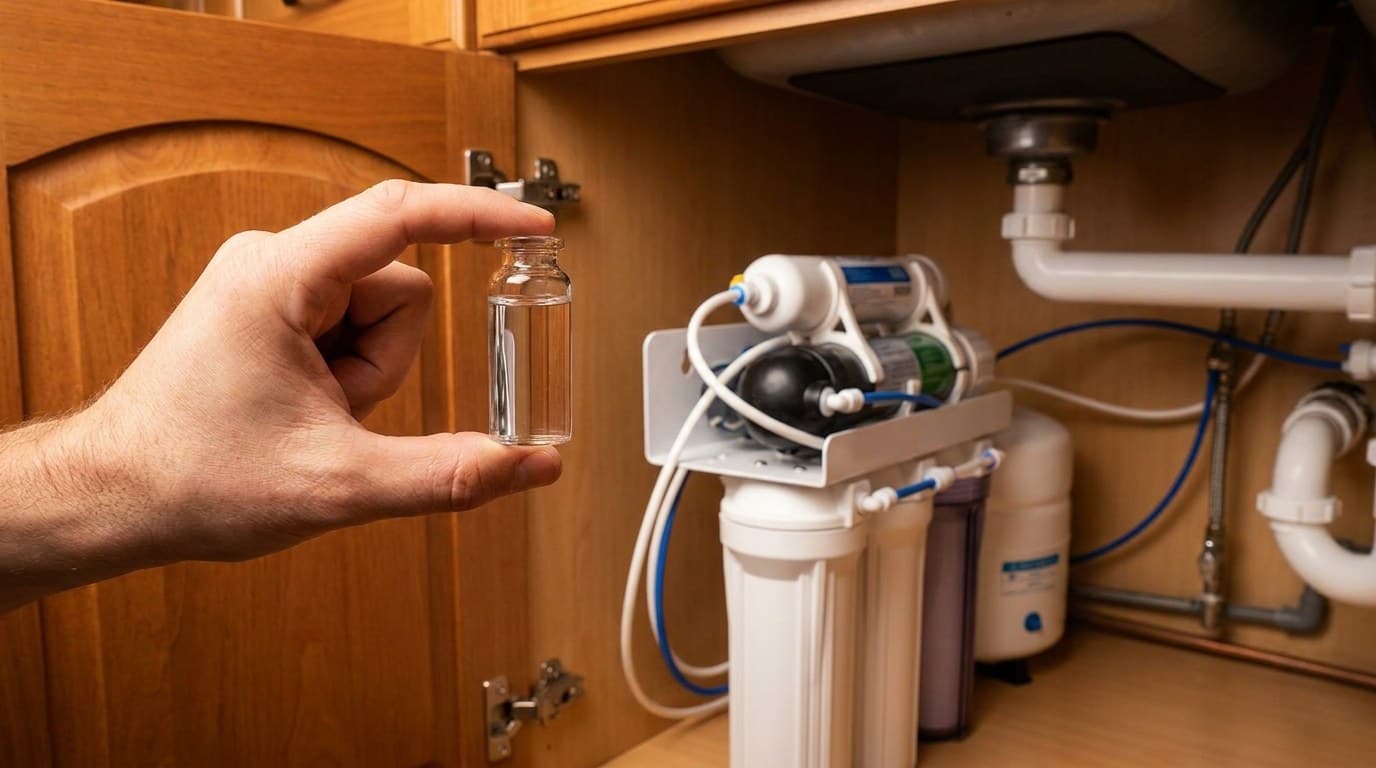
Arsenic in Southern California drinking water
Desert geology puts arsenic into groundwater across the Inland Empire, Imperial Valley, and Coachella Valley. Here is what public data shows about the risk and how NSF-certified filtration removes it.
Arsenic is a naturally occurring element in Southern California groundwater, not a sign of pollution. Desert geology throughout the Inland Empire, Imperial Valley, and Coachella Valley produces groundwater that can exceed the EPA Maximum Contaminant Level of 10 micrograms per liter, according to USGS Professional Paper 1703 and the National Water-Quality Assessment program. Public water utilities regulated under the Safe Drinking Water Act must test and correct elevated arsenic. Private well owners bear that responsibility themselves. An NSF/ANSI Standard 58 certified reverse osmosis system or an NSF/ANSI Standard 53 certified activated alumina filter, sized and installed properly, can reduce arsenic at the tap by 85 to 99 percent. A licensed water quality professional can test your well and recommend the right solution for your water chemistry and household size.
Cleaner water at every tap by sundown. No upsell theater.
Free water test in your kitchen. Lab report in 24 hours. 5-year warranty. 90-day money-back.

Why does Southern California groundwater contain arsenic?
Arsenic in groundwater is almost always a geologic story, not an industrial one, in Southern California. The region sits atop a mosaic of volcanic rocks, marine sedimentary deposits, granitic parent material, and geothermal zones. When rainfall and irrigation water percolate through these formations over decades, they dissolve trace arsenic naturally present in the minerals. The process is slow and invisible, but the result is measurable: USGS researchers documented arsenic concentrations at or above the EPA MCL of 10 ppb in a substantial fraction of groundwater samples from Western desert aquifers, according to Professional Paper 1703, published in 2005 by the U.S. Geological Survey.
Three geologic conditions produce the highest arsenic concentrations in Southern California:
- Volcanic parent rock in San Bernardino County desert communities, where arsenic-bearing minerals weather slowly into the alluvial aquifer system.
- Geothermal activity in the Salton Sea basin and Imperial Valley, where geothermal fluids containing elevated arsenic discharge into shallow aquifers tapped by private wells.
- Evaporative concentration in the Coachella Valley, where decades of irrigation have returned water to the aquifer repeatedly, concentrating naturally occurring arsenic in older groundwater layers.
The EPA Maximum Contaminant Level (MCL) for arsenic in regulated public water systems is 10 micrograms per liter (10 parts per billion), effective January 23, 2006. California adopted the same 10 ppb limit under its domestic water supply regulations. Utilities that exceed the MCL must notify customers, submit corrective action plans, and achieve compliance. Private wells are not regulated under the Safe Drinking Water Act. The full EPA arsenic rule is available at epa.gov/dwreginfo/arsenic-drinking-water.
Arsenic risk by Southern California region
The table below summarizes arsenic occurrence by region, compiled from USGS Professional Paper 1703 (2005), the USGS National Water-Quality Assessment (NAWQA) program, USGS Open-File Report 2004-1120, and the California State Water Resources Control Board public data portal. Regional risk indicates the likelihood that untreated groundwater from a private well or small community well in that area may contain arsenic near or above the 10 ppb MCL. It does not guarantee any individual well will exceed the limit, and it does not apply to large public utilities, which are required to test and treat.
| Region | Aquifer type | Arsenic concern | Primary source |
|---|---|---|---|
| Mojave Desert fringe (San Bernardino County) | Alluvial / volcanic | Naturally elevated from volcanic parent rock | USGS Professional Paper 1703 (2005) |
| Imperial Valley / Salton Sea zone (Imperial County) | Geothermal / alluvial | Geothermal fluids elevate arsenic in shallow aquifers | USGS NAWQA Desert Basin studies |
| Eastern Coachella Valley (Riverside County) | Alluvial basin | Concentration by irrigation return flow; agricultural legacy | USGS Open-File Report 2004-1120 |
| San Gabriel Valley (Los Angeles County) | Urban alluvial | Mixed natural and historic industrial sources | California SWRCB drinking water data portal |
| Temecula / Murrieta basin (SW Riverside County) | Alluvial / granitic | Low to moderate; granitic weathering; monitor private wells | USGS Professional Paper 1703 (2005) |
| Coastal basins (LA, Orange County) | Marine sedimentary | Generally lower; public utilities typically below MCL | USGS Fact Sheet 2002-0171 |
Sources: USGS Professional Paper 1703 (2005, available at pubs.er.usgs.gov); USGS NAWQA Desert Basin studies; USGS Open-File Report 2004-1120; California SWRCB drinking water data portal (waterboards.ca.gov). Arsenic concentrations vary by well depth, age, and local geology. Test your specific well to know your actual level.
How do I test my well water or tap water for arsenic?
Order a Total Arsenic analysis from a California-certified laboratory. The test covers both inorganic arsenate (As(V)) and arsenite (As(III)), the two forms regulated under the Safe Drinking Water Act. Most labs charge $20 to $50 per sample for arsenic analysis alone; a comprehensive well water panel that includes arsenic, nitrates, coliform bacteria, hardness, and pH typically runs $100 to $200 per sample.
Collect the sample as directed by the lab, which usually means flushing the tap for two to five minutes (a standing sample), then filling a clean container provided by the lab. If your result exceeds 10 ppb, confirm with a second test before investing in treatment. The California Environmental Laboratory Accreditation Program (ELAP) lists state-certified labs at waterboards.ca.gov/drinking_water/certlic/labs.
Your utility reports arsenic results in its annual Consumer Confidence Report (CCR), mailed to customers each July. You can also look up your utility in the California State Water Board's online drinking water data portal at waterboards.ca.gov. Violations trigger mandatory public notification within 30 days.
Which water treatment systems remove arsenic?
Arsenic removal requires a specific treatment technology. General-purpose carbon block filters and standard sediment filters do not reliably remove arsenic. The two most widely used and independently certified approaches are reverse osmosis and activated alumina, both available in point-of-use (under-sink) and point-of-entry (whole-home) configurations.
| Treatment method | NSF certification | Typical arsenic reduction | Best for |
|---|---|---|---|
| Point-of-use reverse osmosis | NSF/ANSI 58 | 85 to 95% | Drinking and cooking water at one tap |
| Activated alumina (point-of-use) | NSF/ANSI 53 | 90 to 99% (pH-dependent) | Single-tap well water treatment; requires periodic regeneration |
| Point-of-entry (whole-home) RO | NSF/ANSI 58 | 85 to 95% | Whole-home arsenic removal from private well |
| Iron / manganese / arsenic media | NSF/ANSI 61 (materials only) | Varies by media and contact time | Wells with elevated iron, manganese, and arsenic together |
Reduction percentages based on NSF International performance data for certified products. Actual performance varies by feedwater arsenic concentration, pH, competing ions (especially phosphate and silica), and temperature. For arsenic above 25 ppb, consult a licensed water treatment professional for sizing recommendations.
Does reverse osmosis remove arsenic from well water?
Yes. Reverse osmosis systems certified under NSF/ANSI Standard 58 are tested to remove both arsenate (As(V)) and arsenite (As(III)) from drinking water. RO works by forcing water through a semi-permeable membrane at pressure; the membrane rejects dissolved metals, salts, and other contaminants, passing clean water through to a storage tank while sending concentrated reject water to drain.
A critical note for well water: arsenite (As(III)) is the reduced, uncharged form of arsenic that is harder to remove. Many RO membranes remove arsenate efficiently but perform less well on arsenite. Pre-treating with a chlorine or chloramine disinfectant to oxidize arsenite to arsenate, or with a dedicated oxidation filter, can significantly improve removal rates. A water quality professional who has tested your specific well should specify whether pre-oxidation is needed based on your water chemistry report.
Look for NSF/ANSI Standard 58 certification and confirm that "arsenic" appears on the product's Performance Data Sheet (PDS). The NSF product certification search at nsf.org lists every certified product by standard and contaminant, so you can verify claims before purchasing.
Why private well owners must test on their own
The federal Safe Drinking Water Act and California's equivalent regulations apply only to public water systems, defined as systems that serve 25 or more people or have at least 15 service connections. Private domestic wells serving a single household are excluded. That means no government agency requires your well to be tested for arsenic, and no utility will send you a Consumer Confidence Report telling you what is in your water.
In the areas of Southern California where USGS data shows elevated arsenic risk, including parts of San Bernardino, Riverside, and Imperial counties, private well owners who have never tested are operating on assumption. The California Department of Water Resources recommends testing private wells for arsenic, nitrates, and coliform bacteria at least every three years, or any time the well is serviced, after a nearby wildfire, or after heavy rain events that can disturb aquifer chemistry.
Why the EPA set the arsenic standard at 10 ppb
The EPA lowered the arsenic MCL from 50 ppb to 10 ppb in 2001, with full compliance required by January 2006. The rule change was based on epidemiological studies linking long-term consumption of arsenic in drinking water to increased risk of bladder, lung, and skin cancers, as well as cardiovascular and neurological effects at elevated concentrations. The 10 ppb standard does not mean that water at exactly 10 ppb is completely risk-free; it reflects what EPA determined was achievable through treatment while balancing public health protection and cost.
California's Office of Environmental Health Hazard Assessment (OEHHA) has a public health goal for arsenic of 0.004 ppb, reflecting the theoretical zero-risk level, but the enforceable MCL remains 10 ppb because treatment to near-zero arsenic is not economically feasible for most water systems. For households with confirmed arsenic above 10 ppb, point-of-use treatment at the kitchen tap is the practical path to reducing exposure below the enforceable limit and closer to the public health goal.
Source: OEHHA Public Health Goal for Arsenic (2004); EPA Arsenic Rule (66 FR 6976, January 22, 2001). Consult your physician for health guidance specific to your situation.
Other Southern California water quality guides
Get your well or tap water tested for arsenic
Our licensed technicians serve the Inland Empire, Imperial Valley, Los Angeles, Orange County, and San Diego. We test on-site and recommend NSF-certified treatment sized for your water chemistry, not a generic product.
- Free water test in your kitchen. Nothing charged until you see the lab numbers.
- Three system options, all-in number, four financing terms shown side-by-side.
- 5-year comprehensive warranty. 90-day money-back guarantee.
- Same-day install in most ZIPs. Permits pulled by us.
Arsenic in SoCal water: FAQ
Is there arsenic in Southern California well water?
Yes, naturally occurring arsenic is documented in groundwater across the Inland Empire, Imperial Valley, and Coachella Valley. USGS Professional Paper 1703 (2005) found that desert alluvial aquifers in the Western United States, including Southern California, frequently contain arsenic concentrations that can exceed the EPA Maximum Contaminant Level of 10 micrograms per liter. The source is geologic, not industrial: arsenic leaches from volcanic rocks, marine sedimentary deposits, and geothermal activity common throughout the region. Private well owners are not regulated under the EPA Safe Drinking Water Act, so testing and treatment are the homeowner's responsibility.
What is the EPA limit for arsenic in drinking water?
The EPA Maximum Contaminant Level (MCL) for arsenic in public drinking water systems is 10 micrograms per liter (10 parts per billion), effective January 23, 2006. California adopted the same 10 ppb standard under its domestic water supply regulations. Public water utilities must test for arsenic, report results in their annual Consumer Confidence Report, and take corrective action if levels exceed the MCL. Private well owners are not covered by these rules and must arrange their own testing. The EPA arsenic rule is published at epa.gov/dwreginfo/arsenic-drinking-water.
Which parts of Southern California have the highest arsenic risk in groundwater?
According to USGS Professional Paper 1703 and the National Water-Quality Assessment (NAWQA) program, the highest-risk areas in Southern California include: the Mojave Desert fringe in San Bernardino County (alluvial deposits with volcanic parent rock), Imperial County and the Salton Sea geothermal zone (where geothermal fluids elevate arsenic in shallow aquifers), the eastern Coachella Valley in Riverside County (alluvial deposits concentrated by irrigation return flow), and parts of the San Gabriel Valley in Los Angeles County (mixed industrial and natural sources). Coastal basins generally show lower arsenic levels. Your specific risk depends on the depth, age, and geologic setting of your well.
Does a reverse osmosis system remove arsenic from well water?
Yes. Reverse osmosis systems certified under NSF/ANSI Standard 58 are tested and verified to reduce arsenic at the tap. Certified RO membranes typically reduce total arsenic (both arsenate As(V) and arsenite As(III)) by 85 to 95 percent from the feedwater, according to NSF International test protocols. A point-of-use RO unit under the kitchen sink addresses drinking and cooking water. For whole-home arsenic removal from a private well, a point-of-entry RO system or a whole-home activated alumina filter (NSF/ANSI Standard 53 certified) provides broader coverage.
What test should I use to check my well water for arsenic?
Request a Total Arsenic analysis from a California-certified laboratory. The analysis covers both inorganic arsenate (As(V)) and arsenite (As(III)), the two forms that matter for drinking water. Testing typically costs $20 to $50 per sample. Collect the sample according to the lab's instructions, which usually means flushing the tap for several minutes, then filling a clean container. If arsenic is detected above the EPA MCL of 10 ppb, retest to confirm and then consult a licensed water treatment professional about treatment options. The California Environmental Laboratory Accreditation Program (ELAP) maintains a list of certified labs at waterboards.ca.gov/drinking_water/certlic/labs.
Does a standard water softener remove arsenic?
No. A standard cation-exchange water softener is designed to remove calcium and magnesium hardness ions and does not reliably remove arsenic. Arsenic, particularly arsenite (As(III)), is not captured by standard sodium-form cation resin. Some specialty iron-zirconium media sold for arsenic can be added to a whole-home system, but they are separate products from a water softener and require periodic regeneration or media replacement. For arsenic removal, look for systems certified under NSF/ANSI Standard 58 (RO) or Standard 53 (point-of-use, with arsenic listed on the performance data sheet). A softener and arsenic treatment are often installed together because SoCal well water frequently has both hard water and elevated arsenic.
Ready to know what is in your water?
With 5,000+ installations across Southern California since 2009 and a 90-day satisfaction guarantee, we give you the data and the solution in one visit.
Pick a window for your free water test.
A SoCal Water Treatment tech meets you in your kitchen, runs the test, sends the lab sample. No charge, no commitment.
Request your free water test and we will confirm a window with you directly, usually within the hour.