Reverse osmosis water systems for Los Angeles County.
Los Angeles County tap water delivers chromium-6 above California's public health goal in most LADWP distribution zones, alongside hardness from 280 to 500 mg/L TDS and chloramines as the primary disinfectant. A five-stage NSF 58-certified RO system at the kitchen sink removes all of it.
A five-stage reverse osmosis system certified under NSF/ANSI Standard 58 removes chromium-6, arsenic, nitrates, PFAS, and dissolved solids from Los Angeles County tap water at the kitchen sink. LADWP reports chromium-6 between 0.10 and 0.40 ppb across its distribution zones, compared to California's 0.02 ppb public health goal. NSF 58-certified RO membranes reduce chromium-6 by 85 to 97 percent, PFAS by more than 94 percent, and total dissolved solids by 94 to 99 percent. The system produces 50 gallons of purified water per day and stores it in a pressurized 4-gallon tank under the sink. Southern California Water Treatment installs NSF 58-certified five-stage RO systems across Los Angeles, Orange, San Diego, Riverside, San Bernardino, and Ventura counties, with same-day installation in most service cities.
Pressure forces water through a membrane that blocks dissolved solids at the molecular level.
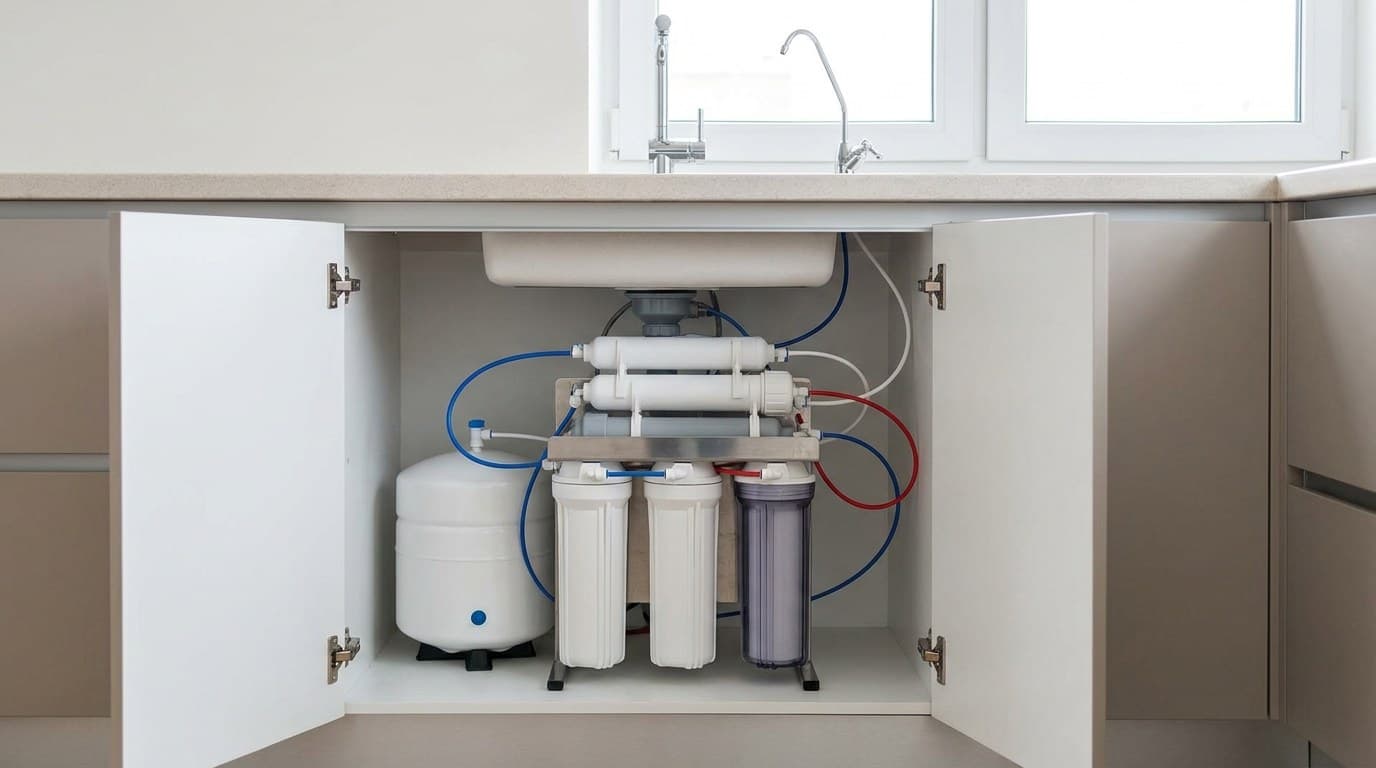
Reverse osmosis uses household water pressure to push tap water across a semipermeable thin-film composite membrane with pores small enough to block dissolved ions, molecules, and microscopic particles. Contaminants that do not pass through are flushed to drain. Purified water collects in a pressurized storage tank and is delivered through a dedicated faucet at the kitchen sink.
The membrane works by size exclusion and ionic charge rejection. Water molecules (H2O) at 0.28 nanometers pass through. Chromium-6 ions, arsenic ions, nitrate ions, PFAS molecules, and dissolved salts are all significantly larger and are rejected at rates of 85 to 99 percent depending on the contaminant and feedwater conditions.
For Los Angeles County water specifically, the high chloramine content (LADWP uses chloramines as the primary disinfectant rather than free chlorine) requires two activated carbon pre-filter stages instead of one, because chloramines break down more slowly than free chlorine. The five-stage systems we install are sized for this water profile.
- 1Sediment pre-filter
Removes silt, rust, and suspended particles down to 5 microns. Protects the carbon stages and the membrane from premature fouling.
- 2Carbon block pre-filter
Removes chlorine, chloramines, and organic compounds. Chlorine degrades RO membranes, so this stage is critical for municipal water.
- 3Second carbon block
A second activated carbon stage for chloramine-heavy supplies such as LADWP, which uses chloramines as the primary disinfectant.
- 4RO membrane
The core stage. A thin-film composite membrane rejects dissolved solids, chromium-6, arsenic, nitrates, PFAS, and most other ionic contaminants at the molecular level.
- 5Remineralizing post-carbon
Adds calcium and magnesium back into purified water, improving taste and replacing beneficial minerals removed by the membrane.
- Output: 50 gallons per day
- Stages: 5 (including remineralization)
- TDS reduction: 94 to 99 percent typical
- Storage tank: 4 gallon pressurized
- Certification: NSF/ANSI 58
- Membrane life: 2 to 3 years (municipal supply)
- Pre-filter interval: 6 to 12 months
- Warranty: 15 years on housing, 12 months on membrane
Specifications reflect standard five-stage under-sink configuration. Fridge and ice-line tap-in available as an add-on at installation.
NSF/ANSI Standard 58 independently tests and verifies contaminant reduction claims, structural integrity, and material safety for point-of-use reverse osmosis systems. Verify any system at nsf.org.
What reverse osmosis removes from Los Angeles County water.
Los Angeles County tap water contains multiple contaminants of concern at levels that exceed California public health goals or federal standards. The table below shows documented concentrations from state-reported monitoring data and the reduction rates achieved by NSF 58-certified RO systems.
| Contaminant | LA County level | CA standard | RO removal rate |
|---|---|---|---|
| Chromium-6 (hexavalent chromium) | 0.10 to 0.40 ppb (LADWP service areas) | 0.02 ppb (OEHHA public health goal) | 85 to 97 percent (NSF 58 certified) |
| Arsenic | 1.1 ppb (LA County detectable average) | 10 ppb MCL (federal and California) | Greater than 95 percent (trivalent and pentavalent) |
| Nitrate | Up to 5.8 ppm in north Orange County groundwater blend | 10 ppm MCL | 85 to 95 percent (NSF 58 certified) |
| PFOA and PFOS (PFAS) | Detectable in multiple SoCal water systems | 4 ppt (EPA MCL, April 2024) | Greater than 94 percent (NSF 58 verified) |
| Total Dissolved Solids (TDS) | 280 to 500 mg/L (LA County blend) | 500 mg/L secondary standard (taste threshold) | 94 to 99 percent (typical membrane rejection rate) |
LA County contaminant levels sourced from California State Water Resources Control Board monitoring reports, LADWP Consumer Confidence Reports, and Environmental Working Group Tap Water Database. RO removal rates reflect NSF/ANSI 58 certification testing at municipal supply concentrations. Actual results vary by feedwater quality.
LADWP reports hexavalent chromium between 0.10 and 0.40 parts per billion across its distribution zones. California's Office of Environmental Health Hazard Assessment set the public health goal at 0.02 ppb, meaning most LADWP service areas deliver chromium-6 at five to twenty times the health-protective threshold.
Standard activated carbon filters, including pitcher-style and refrigerator filters, are not certified for chromium-6 reduction. An NSF 58-certified RO system is the residential standard for reducing chromium-6 in drinking water.
California OEHHA chromium-6 public health goalThe EPA finalized a 4 parts per trillion maximum contaminant level for PFOA and PFOS in April 2024. PFAS detections have been documented in multiple Southern California water systems, including utilities in Orange County and San Diego County. These compounds are collectively known as forever chemicals because they do not break down in the environment.
NSF 58-certified reverse osmosis systems achieve greater than 94 percent reduction of PFOA and PFOS from drinking water at the point of use. This is the most accessible and verified in-home treatment for PFAS contamination.
EPA PFAS National Primary Drinking Water RegulationWhat contaminants are actually in your tap water? The answer is in your kitchen, not a brochure.
A SoCal Water Treatment technician tests your kitchen sink with calibrated strips, meters, and a sample bottle sent to an independent lab. No charge, no pressure. The results come back within 24 hours and determine which system, if any, you actually need.
- Free water test in your kitchen. Nothing charged until you see the lab numbers.
- Three system options, all-in number, four financing terms shown side-by-side.
- 5-year comprehensive warranty. 90-day money-back guarantee.
- Same-day install in most ZIPs. Permits pulled by us.
What NSF 58 certification actually guarantees.
NSF/ANSI Standard 58, developed by NSF International and ratified by the American National Standards Institute, is the governing certification for residential point-of-use reverse osmosis drinking water systems sold in the United States. Certification under this standard requires independent laboratory testing at an NSF-accredited facility, not self-reporting by the manufacturer.
The standard covers three areas. First, contaminant reduction: the system must achieve the claimed reduction percentage for each contaminant listed on the certification at the concentration specified in the standard. Second, structural integrity: the system housing and connections must withstand pressure testing without leaking. Third, material safety: all wetted components must not introduce new contaminants into the treated water above threshold levels.
For Los Angeles County homeowners evaluating a reverse osmosis system, the practical check is to look for the NSF 58 certification mark on the product and verify the specific contaminants listed in the NSF Certified Drinking Water Treatment Units database at nsf.org. Chromium-6 and PFAS reduction must be listed explicitly. Not all NSF 58-certified systems are certified for every contaminant within the standard's scope.
All reverse osmosis systems we install carry NSF 58 certification covering the specific contaminants documented in Los Angeles County, Orange County, and San Diego County water supplies. We provide the certification documentation at installation.
- NSF 58-certified reverse osmosisChromium-6: Yes (85 to 97%)PFAS: Yes (94%+)Nitrates: Yes (85 to 95%)Arsenic: Yes (95%+)
- Activated carbon pitcher filter (NSF 42)Chromium-6: NoPFAS: Partial (varies)Nitrates: NoArsenic: No
- Water softener (ion exchange)Chromium-6: NoPFAS: NoNitrates: PartialArsenic: No
- UV disinfectionChromium-6: NoPFAS: NoNitrates: NoArsenic: No
Removal rates reflect NSF/ANSI certification testing. Carbon filter PFAS removal varies by specific compound and filter media. Source: NSF International at nsf.org.
Reverse osmosis installation across Southern California.
We install NSF 58-certified five-stage RO systems in Los Angeles County and six adjacent counties. Each installation is sized to the water profile of the specific city, because chromium-6 levels, TDS, and disinfection method differ by utility and ZIP code.
Service cities include Burbank, Pasadena, Whittier, Irvine, Tustin, Anaheim, San Diego, Carlsbad, Encinitas, Riverside, Corona, Temecula, Rancho Cucamonga, Ontario, Ventura, Oxnard, Thousand Oaks, El Centro, Brawley, Calexico. Contact us to confirm coverage for your ZIP code.
Reverse osmosis questions for Los Angeles County homeowners.
Does reverse osmosis remove chromium-6 from Los Angeles County water?
Yes. Reverse osmosis systems certified under NSF/ANSI Standard 58 are independently tested and verified to reduce hexavalent chromium. In laboratory testing at concentrations typical of Los Angeles County municipal supplies, certified RO membranes reduce chromium-6 by 85 to 97 percent. LADWP reports chromium-6 at 0.10 to 0.40 ppb in many distribution zones, compared to California's public health goal of 0.02 ppb set by the Office of Environmental Health Hazard Assessment. An NSF 58-certified RO system at the kitchen sink brings drinking water below that threshold. Source: California OEHHA at oehha.ca.gov.
Does reverse osmosis remove PFAS from Southern California tap water?
Yes. NSF/ANSI Standard 58-certified reverse osmosis systems are verified to remove PFOA and PFOS, the two PFAS compounds subject to EPA's 4 parts per trillion maximum contaminant levels finalized in April 2024. In independent testing, RO membranes typically achieve greater than 94 percent removal of PFOA and PFOS from drinking water at the point of use. PFAS detections in Southern California have been documented in multiple Orange County and San Diego County water systems. Source: EPA PFAS Rule, April 2024, at epa.gov.
What NSF certification does a reverse osmosis system need?
For drinking water treatment, NSF/ANSI Standard 58 is the relevant certification for reverse osmosis systems. NSF 58 independently tests and verifies contaminant reduction claims made by the manufacturer, covers the structural integrity of the system, and specifies the test conditions and concentrations for each certified contaminant. When evaluating a system, look for the NSF mark on the product and verify the specific contaminant claims listed in the NSF product registry at nsf.org. Our installed systems carry NSF 58 certification.
How much water does a residential reverse osmosis system produce per day?
A standard five-stage under-sink reverse osmosis system produces approximately 50 gallons of purified water per day from a typical Southern California municipal supply. That covers drinking, cooking, and ice production for most households. Actual output depends on incoming water pressure, temperature, and total dissolved solids. LA County tap water at 280 to 500 mg/L TDS is well within the operating range of standard residential RO membranes. A pressurized 4-gallon storage tank holds purified water between draws so the dedicated faucet delivers immediately.
Do I need a whole-home RO system or an under-sink system?
For drinking and cooking water, an under-sink point-of-use system is the appropriate and cost-effective choice for most Los Angeles County homes. Whole-home RO is expensive to purchase, requires significant water pressure, and wastes substantially more water than point-of-use. The better approach for whole-home water quality in SoCal is a combination: a whole-home filtration or softener system to address hardness, chlorination byproducts, and scale, paired with a point-of-use RO unit at the kitchen sink for purified drinking water. We design both stages to work together.
How often do reverse osmosis filters need to be replaced?
A standard five-stage RO system has three consumable components with different service intervals. Sediment and carbon block pre-filters: every 6 to 12 months. The RO membrane: every 2 to 3 years under normal municipal supply conditions. The post-carbon remineralizing stage: every 12 months. Total annual maintenance cost depends on the system and the local water quality, but most households budget $60 to $120 per year in replacement filters. We include a filter-replacement reminder service with every installation.
Find out what is actually in your tap water.
A SoCal Water Treatment technician tests your kitchen sink with calibrated equipment and sends a sample to an independent lab. If your water shows chromium-6, arsenic, PFAS, or other contaminants above the thresholds in this guide, we size a system to address your specific numbers. No charge for the test. No obligation.
- Free in-home water test at your kitchen sink
- Independent lab results within 24 hours
- NSF 58-certified RO systems, same-day installation available
- 5,000+ installations across Southern California since 2009
- 5-year warranty on tanks, valves, and labor
- 90-day satisfaction guarantee
Pick a window for your free water test.
A SoCal Water Treatment tech meets you in your kitchen, runs the test, sends the lab sample. No charge, no commitment.
Request your free water test and we will confirm a window with you directly, usually within the hour.
Cleaner water at every tap by sundown. No upsell theater.
Free water test in your kitchen. Lab report in 24 hours. 5-year warranty. 90-day money-back.