Water softener installation for Los Angeles.
Los Angeles and Orange County tap water delivers 18 to 30 grains per gallon of hardness from the Metropolitan Water District blend, scaling appliances, dulling hair, and shortening water heater life by years. A correctly sized NSF/ANSI 44-certified softener solves all of it from one point at the main water line.
Los Angeles County tap water is very hard. The Metropolitan Water District blend that supplies most LADWP customers arrives at 18 to 28 grains per gallon (GPG), enough to leave white scale on fixtures within weeks and reduce water heater efficiency by up to 30 percent over time. A salt-based ion-exchange softener certified under NSF/ANSI Standard 44 is the only residential system that actually removes calcium and magnesium from the water supply, eliminating scale at every tap, shower, and appliance. SoCal Water Treatment has installed more than 5,000 softening systems across Los Angeles, Orange County, and the Inland Empire since 2009, with same-day completion in 94 percent of installations. Every system carries a 5-year warranty and a 90-day full-refund guarantee.
Why Los Angeles and Orange County water is so hard.
The Metropolitan Water District of Southern California (MWD) delivers water to most of the region by blending two raw sources: State Water Project water pumped from the Sacramento-San Joaquin Delta, and Colorado River water that transits the Colorado River Aqueduct. Both sources are naturally high in dissolved calcium and magnesium. The Colorado River arm delivers hardness of 250 to 300 mg/L as calcium carbonate on its own. The blended product that reaches LADWP distribution zones tests at approximately 308 to 479 mg/L, equivalent to 18 to 28 GPG. Local groundwater wells in the San Gabriel Valley, parts of Orange County, and the Inland Empire add additional hardness from limestone and gypsum geology and can reach 35 GPG or higher.
Hardness is measured in grains per gallon (GPG) or milligrams per liter (mg/L) of calcium carbonate equivalent. The U.S. Geological Survey classifies water above 10.5 GPG as very hard. At 18 to 30 GPG, Southern California sits in the hardest tier of any major U.S. metro area. That translates to visible scale on showerheads within two to three weeks of installation, spot deposits on glassware within days, and a measurable reduction in soap lathering efficiency that increases the amount of detergent needed for effective cleaning.
Southern California hardness by water district.
| Service area | Typical hardness (GPG) | As mg/L CaCO3 | Source |
|---|---|---|---|
| LADWP service area (MWD import blend) | 18 to 25 GPG | 308 to 428 mg/L as CaCO3 | Metropolitan Water District |
| Orange County Water District (groundwater blend) | 16 to 22 GPG | 274 to 376 mg/L as CaCO3 | Orange County Water District |
| San Gabriel Valley (local groundwater) | 22 to 30 GPG | 376 to 514 mg/L as CaCO3 | California State Water Board |
| Inland Empire (Riverside and San Bernardino County) | 22 to 35 GPG | 376 to 599 mg/L as CaCO3 | California State Water Board |
| Ventura County (Calleguas MWD blend) | 15 to 22 GPG | 257 to 376 mg/L as CaCO3 | Metropolitan Water District |
Salt-based, salt-free, and TAC: which is right for your Los Angeles home.
Three categories of equipment are marketed as water softeners in Los Angeles. They work differently and produce different results. Understanding the distinction before purchasing saves money and prevents the frustration of installing a system that does not solve the problem you actually have.
Template-assisted crystallization (TAC) is a useful technology for specific situations, including jurisdictions that restrict brine discharge from ion-exchange softeners. The Santa Clarita Valley and parts of Inland Empire communities have adopted discharge limits. For most of Los Angeles County, Orange County, and coastal communities, salt-based ion exchange remains the standard installation. We assess local regulations before recommending a system type for your address.
What NSF/ANSI 44 certification means for your water softener.
NSF/ANSI Standard 44 is the independent certification benchmark for residential cation exchange water softeners in the United States. Published by NSF International under accreditation from the American National Standards Institute, it sets the test protocols and pass criteria that manufacturers must meet before applying the NSF 44 mark to a product.
The system must demonstrate it reduces hardness to the level claimed on the label, tested at the rated capacity and under the specified conditions.
Tanks, valves, and control heads must withstand the working pressures and cycling frequencies specified in residential use, including simulated long-term stress.
All materials in contact with drinking water must not leach contaminants above the NSF/ANSI 61 limits. This includes resins, brine tanks, and any plastic components.
NSF 44 requires manufacturers to publish a salt efficiency rating expressed as grains of hardness removed per pound of salt used. Higher efficiency means lower operating cost.
Before purchasing a softener, verify the NSF 44 listing at nsf.org. The listing includes the certified capacity, the efficiency rating, and the exact contaminants tested. A product with the NSF 44 logo printed on its box but not listed in the registry has not passed independent testing. All softeners we install carry a current NSF 44 listing.
How water softener installation works in Los Angeles.
A properly sized softener handles your actual water use and incoming hardness without running short between regeneration cycles or regenerating so frequently that it wastes salt and water. Undersized systems let hard water through when the resin bed is exhausted. Oversized systems regenerate on timers that do not match actual demand, wasting salt. We size every installation from a measured hardness test, not a ZIP code estimate.
A technician measures your incoming hardness, TDS, iron, and pH at the cold-water supply. The test determines the grain capacity and valve type required for your household size and water profile.
We match capacity to your daily demand in grains. For a four-person LA County household at 22 GPG, that is typically a 48k to 64k grain unit. You receive three options with clear tradeoffs.
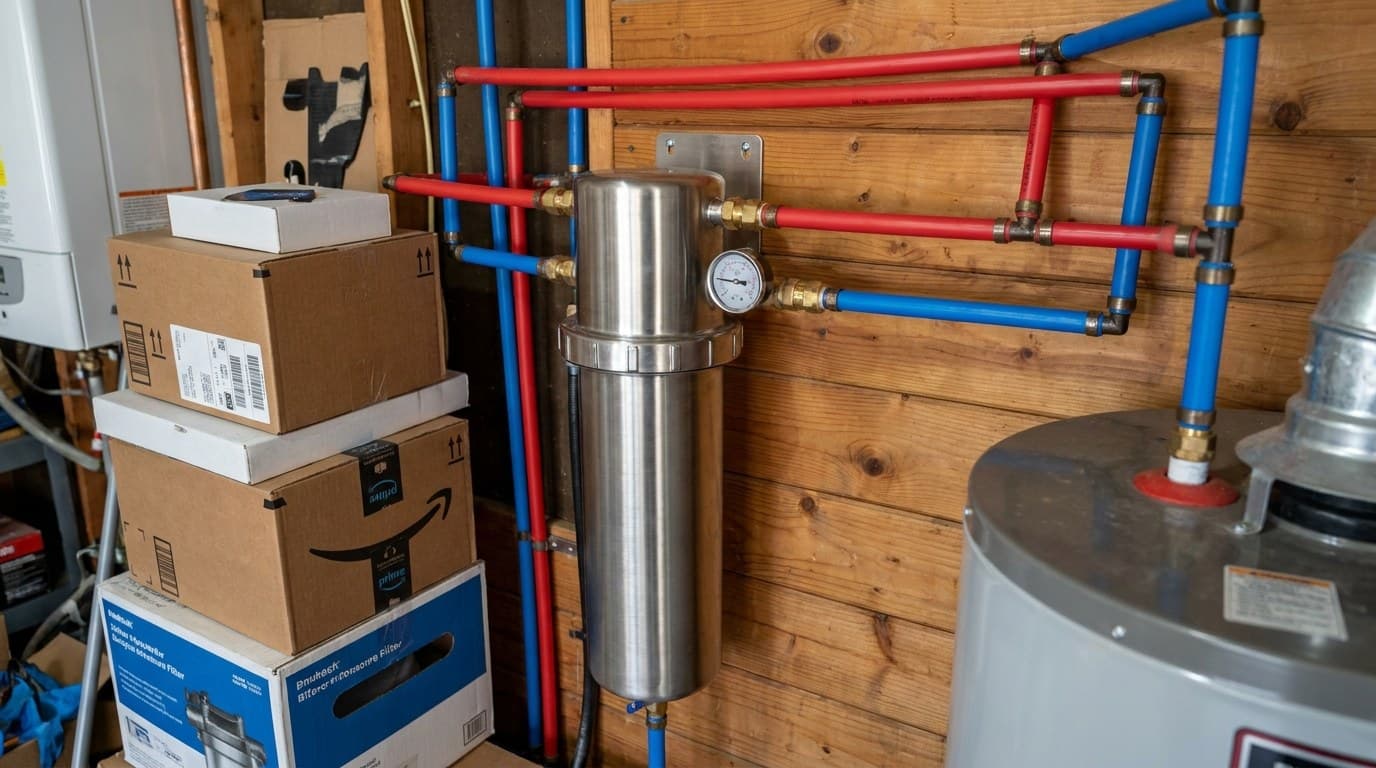
94 percent of our installations complete in a single visit. The softener connects at the main water line after the meter, before any branch serving indoor plumbing. Your water tests soft before we leave.
- 5,000+ installations since 2009
- 94% same-day completion rate
- 5-year comprehensive warranty
- 90-day full-refund guarantee
- NSF/ANSI 44 and 58 certified systems
- CA C-55 license #1085921
Find out exactly how hard your water is. We test your home, not a ZIP code.
A SoCal Water Treatment technician tests your kitchen cold supply, logs the hardness and TDS, and returns a sized recommendation with three options and no pressure. The test is free.
- Free water test in your kitchen. Nothing charged until you see the lab numbers.
- Three system options, all-in number, four financing terms shown side-by-side.
- 5-year comprehensive warranty. 90-day money-back guarantee.
- Same-day install in most ZIPs. Permits pulled by us.
Water softener installation across Southern California.
We serve Los Angeles County, Orange County, the Inland Empire, San Diego County, Ventura County, and San Bernardino County. Every county has its own hardness profile and, in some cases, its own local discharge regulations that affect which softener type is appropriate. We know which rules apply at your address before we arrive.
This page is the pillar for our water softener hub. Detailed installation guides for Orange County and the Inland Empire are in production, covering the distinct hardness profiles and local regulations that affect system selection in each area.
- Orange County water softener installation covering OCWD groundwater blend (16 to 22 GPG), discharge compliance, and Irvine-specific hardness data
- Inland Empire water softener installation covering Riverside and San Bernardino County groundwater (22 to 35 GPG), local restrictions, and iron co-treatment for well water connections
More resources for Southern California homeowners.
Pick a window for your free water test.
A SoCal Water Treatment tech meets you in your kitchen, runs the test, sends the lab sample. No charge, no commitment.
Request your free water test and we will confirm a window with you directly, usually within the hour.
Cleaner water at every tap by sundown. No upsell theater.
Free water test in your kitchen. Lab report in 24 hours. 5-year warranty. 90-day money-back.