Lead in Southern California tap water is primarily a plumbing problem, not a utility problem. Major distributors including LADWP, Burbank Water and Power, and San Diego Public Utilities report 90th percentile tap results below the EPA action level in their annual Consumer Confidence Reports, per California State Water Resources Control Board Lead and Copper Rule compliance data. The real risk sits inside homes built before 1986, when Congress amended the Safe Drinking Water Act to ban lead solder and flux in potable plumbing systems. Older Los Angeles neighborhoods, where a large share of the housing stock predates that ban, concentrate the exposure risk. California schools have undergone mandatory testing under AB 746, with Los Angeles Unified finding detections above 15 ppb at a subset of aging fixtures. NSF/ANSI 53 and 58 certified filters remove lead reliably from drinking water taps.
How does lead get into Southern California tap water?
Lead does not appear in Southern California source water at concentrations that concern public health regulators. The Colorado River, State Water Project conveyances, and local groundwater sources that supply SoCal utilities carry lead at or near detection limits in raw water monitoring. The exposure pathway is almost entirely from materials in the distribution and plumbing systems between the treatment plant and the tap.
Three physical sources account for the overwhelming majority of lead detections at residential taps in Southern California:
- Lead service lines: The underground pipe connecting the utility main in the street to the meter at the property boundary. In Los Angeles, older neighborhoods including Boyle Heights, El Sereno, and parts of South Los Angeles retain lead service lines on the utility side in some cases. California utilities are now required to inventory these lines and replace them under the 2021 Lead and Copper Rule Revisions and the 2024 Lead and Copper Rule Improvements.
- Lead solder at pipe joints: Before the 1986 Safe Drinking Water Act amendment, lead-based solder (typically 50 percent lead, 50 percent tin) was the standard material for joining copper pipe in residential plumbing. Any home with copper pipe installed before 1986 may have lead solder at hundreds of joints. The solder does not leach continuously, but during stagnation periods (overnight, extended absence), lead dissolves into standing water at those joints and concentrates in the first draw of water.
- Brass fixtures and fittings: Faucets, valves, and connectors made before 2014 could legally contain up to 8 percent lead under federal standards. California adopted stricter standards earlier (AB 1953, effective 2010), but fixtures imported from outside California or installed before that date may still leach lead. A 2014 federal amendment to the Safe Drinking Water Act reduced the allowable lead content in fixtures to 0.25 percent weighted average, but legacy fixtures remain in place throughout the SoCal housing stock.
The California Department of Drinking Water (DDW), a division of the State Water Resources Control Board, maintains the regulatory framework for lead monitoring under the federal Lead and Copper Rule. Public water systems serving more than 50 people must sample tap water at high-risk residences (those most likely to have lead plumbing) on a periodic schedule and report 90th percentile results. A result above the action level triggers mandatory notification and treatment changes.
What the SWRCB Lead and Copper Rule compliance data shows for Southern California
California utilities report Lead and Copper Rule tap sample results to the State Water Resources Control Board Division of Drinking Water. Consumer Confidence Reports published annually by each utility summarize the 90th percentile lead result, which represents the tap result at the 90th percentile of the sample population. A result below 15 ppb (the former action level) or below the new 10 ppb threshold finalized in October 2024 means the utility is in compliance, not that every tap in the service area is lead-free.
| Utility | County | 90th pct result | Report year |
|---|---|---|---|
| Los Angeles DWP | Los Angeles | 2 ppb | 2023 |
| Burbank Water and Power | Los Angeles | < 1 ppb | 2023 |
| San Diego Public Utilities | San Diego | 3 ppb | 2023 |
| Eastern Municipal Water District | Riverside | 4 ppb | 2023 |
| Inland Empire Utilities Agency | San Bernardino | 2 ppb | 2023 |
| Mesa Water District | Orange | < 1 ppb | 2023 |
Source: Individual utility Consumer Confidence Reports, filed with the California State Water Resources Control Board. The 90th percentile result represents the tap sample at the 90th percentile, not the average across all taps. Verify current results at waterboards.ca.gov/drinking_water.
These aggregate results do not mean that no tap in these service areas delivers lead above the action level. The LCR sampling protocol intentionally selects high-risk residences, and the 90th percentile metric means that 10 percent of the tested sites in each sample period returned results above the reported number. Individual homes with older plumbing can return first-draw lead results well above the utility-wide 90th percentile figure.
The full Lead and Copper Rule compliance database for California, including individual utility sample results and action level exceedances, is maintained by the California DDW and is searchable through the Electronic Annual Report (EAR) system at waterboards.ca.gov/drinking_water.
Los Angeles housing stock and the pre-1986 lead plumbing risk
The Los Angeles metropolitan area has one of the largest concentrations of pre-1986 housing in the western United States. U.S. Census American Community Survey data on housing age shows that a substantial portion of the existing LA County housing stock was built before 1980, concentrated in the urban core neighborhoods of central and east Los Angeles, the older Westside communities, and much of the San Fernando Valley.
For homeowners in these areas, the 1986 date is not just regulatory history but a practical dividing line for plumbing risk assessment. Homes built or substantially replumbed after 1986 using copper pipe installed with lead-free solder carry very low risk from pipe joints. Homes built before 1986, or where plumbing was last touched before that date, carry a meaningful probability of lead solder at every soldered joint in the system.
Key regulatory timeline
- 1930 and earlier: Lead service lines common in older city cores. Some remain in place in parts of historic downtown Los Angeles and pre-war neighborhoods.
- Before 1986: Lead-based solder (50 percent lead) used in copper pipe installation per standard industry practice. Banned under the Safe Drinking Water Act amendment effective 1986.
- Before 2010 (California) / 2014 (federal): Brass fixtures could contain up to 8 percent lead. California AB 1953 took effect in 2010; federal rules followed in 2014.
- October 2024: EPA Lead and Copper Rule Improvements lower the action level from 15 ppb to 10 ppb. Full text at epa.gov/sdwa/lead-and-copper-rule-revisions.
The stagnation effect is the critical mechanism homeowners should understand. Lead does not dissolve into flowing water at the same rate as stagnant water. After 6 to 8 hours without use, the water sitting in contact with lead solder joints absorbs lead. The first half-liter to one liter drawn from the tap in the morning carries the highest lead concentration in a home with pre-1986 solder. Flushing the tap for 30 seconds before drinking disperses this concentrated water, though it does not address the underlying source.
LAUSD school water testing: what the AB 746 data showed
California AB 746, signed by Governor Brown in 2017 and later expanded, requires all K-12 public schools to test drinking water outlets for lead. The program uses a risk-based approach: water is sampled after overnight stagnation (first draw), which captures the lead contributed by fixtures and nearby pipe segments that have been in contact with standing water.
Los Angeles Unified School District, which operates hundreds of campuses across Los Angeles County and serves approximately 425,000 students, completed system-wide outlet testing across its campuses. The testing program identified lead detections above 15 parts per billion at a portion of outlets, concentrated in the following outlet types:
- Older drinking fountains, particularly those manufactured before the 1980s with internal lead alloy components
- Kitchen prep sinks in cafeteria facilities where lead solder in older supply lines contacts water
- Hose bibs and janitor sinks, which are not intended for drinking but were included in comprehensive testing programs
- Classroom sinks in pre-1980 buildings where interior plumbing had not been updated
LAUSD remediated affected outlets by replacing fixtures, installing NSF-certified point-of-use filters, or taking outlets out of service. Current testing results by campus are available through the California Department of Education's school water testing results portal. The California DDW maintains statewide oversight of school testing compliance and publishes summary data on the proportion of tested schools with action-level detections.
The pattern found in LAUSD mirrors national findings in school water testing: campus age is the strongest predictor of detection rates, with pre-1980 buildings showing meaningfully higher rates than post-1986 construction. The mechanism is the same as residential exposure: fixture age, solder age, and stagnation time determine how much lead enters the water at any given outlet.
How to find out if your home has lead in the tap water
Three steps cover assessment for most Southern California homeowners in pre-1986 housing:
- Request your utility's service line inventory: California utilities are required to maintain a record of lead service lines, galvanized service lines, and service lines of unknown material. LADWP, San Diego Public Utilities, and other large SoCal utilities have published their inventories. Contact your utility's customer service line or visit the utility website. If your service line is flagged as unknown or lead, the utility is required to replace it on a timeline defined by the 2024 LCRI.
- Identify your home's construction date and plumbing history: County assessor records, building permit records, and the original real estate disclosure documents typically include construction date and major renovation history. If the plumbing was substantially replaced after 1986 and you have documentation of that work, the interior solder risk is likely low. If the original copper plumbing remains from before 1986, assume lead solder is present.
- Test with a California ELAP-certified laboratory: The California Environmental Laboratory Accreditation Program certifies laboratories authorized to analyze drinking water samples. The State Water Resources Control Board publishes the ELAP-certified laboratory list at waterboards.ca.gov/drinking_water/certlic/labs. Collect first-draw samples following overnight stagnation (at least 6 hours without running any water in the home) to capture the worst-case scenario for lead exposure from your plumbing. The laboratory will specify the exact sampling protocol. Request analysis for lead specifically (EPA Method 200.8 or ICP-MS), not a general metals panel.
Los Angeles County Department of Public Health and individual municipal health departments periodically offer reduced-cost or free lead testing programs for households with young children or pregnant residents. Contact your county health department to ask about current programs. The CDC's blood lead level reference value for children is 3.5 micrograms per deciliter, and even sub-action-level water lead can contribute to cumulative exposure in young children.
Which water filters remove lead from Southern California tap water?
Two categories of NSF-certified filtration reliably remove lead at the residential tap. Not all water filters are tested for lead, and several common filter types provide no meaningful lead reduction.
NSF/ANSI 58 certified reverse osmosis (point of use)
Reverse osmosis systems certified to NSF/ANSI Standard 58 are tested for lead reduction as part of the certification protocol. Independent testing shows typical lead reduction of 95 percent or more across the membrane under certified conditions. A point-of-use RO unit installed under the kitchen sink delivers treated water at a dedicated tap, addressing drinking and cooking water at the point most relevant to lead ingestion. The membrane separates dissolved lead salts regardless of whether the source is the utility main, the service line, or in-home solder joints.
Verify current certification at nsf.org. Not all RO systems carry the lead reduction certification even if they are certified under NSF/ANSI 58 for TDS reduction. Confirm the specific lead claim in the product's NSF listing.
NSF/ANSI 53 certified filters for lead reduction
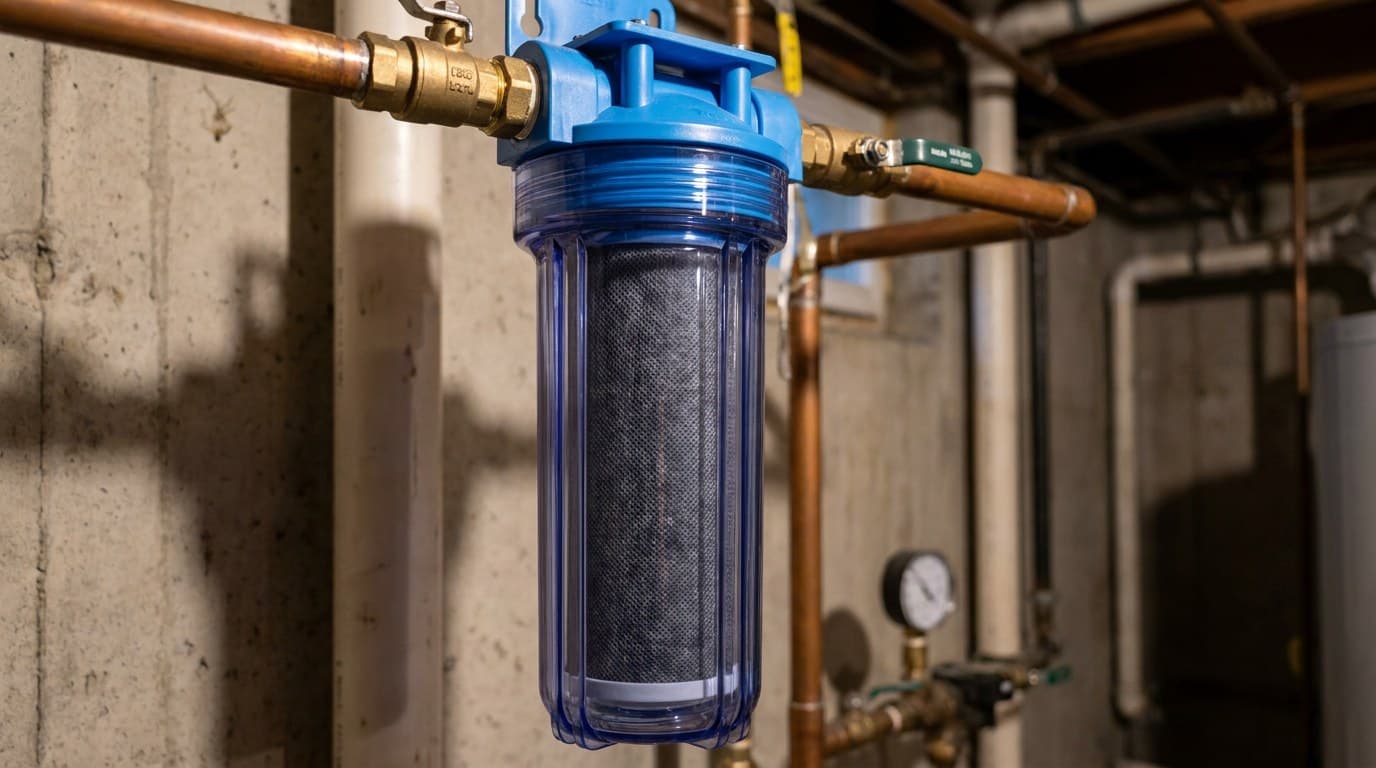
NSF/ANSI Standard 53 covers health effects contaminant reduction. Filters certified under NSF/ANSI 53 specifically for lead use activated carbon with ion exchange media or lead-specific adsorption media. Point-of-use under-sink units, whole-house inline filters, and some pitcher filters carry this certification. Whole-house units certified under NSF/ANSI 53 for lead reduction address lead from in-home plumbing throughout all taps in the home. Confirm the lead reduction claim specifically in the NSF product listing, as many NSF/ANSI 53 certified filters are certified only for chlorine taste and odor reduction, not lead.
Filters that do not reliably remove lead
Standard activated carbon filters not certified under NSF/ANSI 53 for lead do not reliably remove dissolved lead. Water softeners, which use cation exchange resin designed to capture calcium and magnesium hardness ions, are not certified for lead reduction and should not be relied upon for lead removal. UV disinfection systems address microbiological contaminants only and have no effect on dissolved lead. Sediment filters remove particulate matter but not dissolved lead salts.
For homes with documented lead solder or lead service lines, the most comprehensive residential approach combines a whole-house NSF/ANSI 53 certified lead-reduction filter at the point of entry with an NSF/ANSI 58 certified RO unit at the kitchen tap. The whole-house filter addresses all taps including bathrooms, where lead exposure via bathing is lower than via drinking but still a consideration. The RO unit provides the highest reduction performance at the primary drinking water source.
Southern California's hard water (typically 200 to 400 mg/L total dissolved solids in many service areas) creates an additional consideration for RO system selection: membrane sizing, flushing schedules, and pre-treatment for scale control all affect long-term lead reduction performance. See the reverse osmosis guide for Southern California homes for system sizing guidance specific to SoCal water chemistry.
Related Southern California water quality guides
Lead is one of several contaminants documented in Southern California tap water by state and federal monitoring programs. The guides below cover the broader water quality picture across the region and specific treatment technologies relevant to SoCal homes.
Related guides for Southern California homeowners
- Southern California water quality by county 2026: verified data for LA, Orange, San Diego, Riverside, San Bernardino, Ventura, and Imperial counties
- Reverse osmosis for Southern California homes: how RO systems work, what they remove, and how to size one for your water chemistry
- Chromium-6 in Southern California water: EPA UCMR3 data, state monitoring records, and NSF-certified removal options
- Lead in Southern California drinking water: what the 2024 EPA Lead and Copper Rule Improvements mean for SoCal utility customers
- Chromium-6 in Southern California tap water: what state and federal testing shows by county
- PFAS in Southern California water: what the 2024 EPA data shows by county
Frequently asked questions about lead in Southern California tap water
Is there lead in Los Angeles tap water?
Lead in Los Angeles tap water comes primarily from in-home plumbing rather than the utility's distribution main. LADWP 2023 Consumer Confidence Report data shows a 90th percentile lead result at the tap of 2 parts per billion, well below both the former 15 ppb action level and the new 10 ppb threshold finalized in the EPA Lead and Copper Rule Improvements of October 2024. However, homes built before 1986 may contain lead solder at pipe joints, and fixtures made before 1988 can leach lead regardless of the utility's source water quality. The California State Water Resources Control Board's Lead and Copper Rule compliance database tracks results for regulated utilities statewide.
How do I know if my home has lead plumbing in California?
If your California home was built before 1986, the year Congress amended the Safe Drinking Water Act to ban lead solder and flux in potable plumbing, there is a meaningful chance that lead solder was used at joints inside your walls. Homes built before 1930 in older Los Angeles neighborhoods, including Boyle Heights, Highland Park, and Echo Park, may have lead service lines on the property side of the meter. California utilities are required under the 2021 Lead and Copper Rule Revisions to maintain a lead service line inventory, which you can request from your utility. A first-draw tap water test by a California ELAP-certified laboratory, following overnight stagnation, is the most direct way to determine your actual exposure at the tap.
Do Southern California schools have lead in the water?
California AB 746, signed in 2017 and later expanded, requires all K-12 public schools to test drinking water outlets for lead. Los Angeles Unified School District, the largest district in California, completed system-wide testing and found lead above 15 parts per billion at a portion of fixtures tested, most commonly at older drinking fountains, kitchen prep sinks, and hose bibs not intended for drinking. LAUSD remediated affected fixtures and results are available through the California Department of Education's School Water Testing portal. Results varied significantly by campus age, with pre-1980 buildings showing higher detection rates than newer construction.
What does the EPA 2024 lead rule change mean for homeowners?
The EPA Lead and Copper Rule Improvements, finalized October 8, 2024, lowered the lead action level from 15 parts per billion to 10 parts per billion and set a goal of eventually eliminating lead service lines nationwide. California utilities that exceed 10 ppb at the tap must take immediate remediation steps and notify affected customers. All utilities must complete a lead service line inventory and replace any lead service lines they own within 10 years of the rule's effective date. For homeowners, the rule does not directly regulate in-home plumbing, but it increases the information available through utility-provided Consumer Confidence Reports and service line inventories.
What filter removes lead from tap water in Southern California?
Two categories of NSF-certified filters reliably remove lead from tap water. Reverse osmosis systems certified under NSF/ANSI Standard 58 reduce lead at the point of use, typically a dedicated kitchen tap, by more than 95 percent in independent testing. Inline and pitcher filters certified under NSF/ANSI Standard 53 for lead reduction use activated carbon with ion exchange media to reduce lead at one outlet. The NSF certified product registry at nsf.org lists every product tested and certified for lead reduction. Not all carbon filters are certified for lead, so confirm the NSF/ANSI 53 or 58 designation before purchasing. Whole-house systems certified under NSF/ANSI 53 address lead from in-home plumbing throughout the home.
- EPA Lead and Copper Rule Improvements (LCRI), finalized October 2024
- California State Water Resources Control Board Division of Drinking Water: Lead and Copper Rule compliance data
- California DDW Electronic Annual Report (EAR) system: utility-level CCR and monitoring data
- California AB 746 school water testing program: background and requirements
- NSF International: certified drinking water treatment unit database
- California ELAP-certified laboratory list for drinking water analysis
- Safe Drinking Water Act: Lead solder ban history (1986 amendment), EPA background
- ATSDR toxicological profile for lead: health effects of lead in drinking water