
Chromium-6 in San Diego County Water
California SWRCB data documents hexavalent chromium in the El Cajon Basin and South Bay water supplies. Here is what the public record shows and how to protect your home.
San Diego County draws approximately 80 percent of its drinking water from imported sources through the San Diego County Water Authority, primarily Colorado River water blended with State Water Project supplies. The remaining supply comes from local reservoirs and groundwater wells, concentrated in the East County basins around El Cajon and in the South Bay area around Chula Vista. The California State Water Resources Control Board's Drinking Water Watch database documents hexavalent chromium detections in multiple San Diego County water systems, reflecting both naturally occurring chromium-6 in groundwater and trace levels carried by Colorado River imports. California's public health goal for chromium-6 is 0.02 ppb; the enforceable Maximum Contaminant Level was re-established at 10 ppb in October 2024. Many San Diego supplies detect levels above the health goal but below the MCL. This guide covers which water districts and cities face the greatest documented exposure, where to find current monitoring data, and which NSF-certified filtration systems reduce hexavalent chromium at your tap.
Does San Diego County tap water contain chromium-6?
Yes. The California State Water Resources Control Board maintains a publicly searchable database of drinking water monitoring results called Drinking Water Watch, available at waterboards.ca.gov. When queried for San Diego County water systems, that database shows hexavalent chromium detections in multiple utilities serving the county. The detections reflect two distinct sources: naturally occurring chromium-6 mobilized from geological formations in the Peninsular Ranges and Mojave Desert that feed the Colorado River, and trace chromium-6 in groundwater basins tapped by East County and South Bay districts.
Detections in San Diego County are generally lower than those documented in the San Gabriel Valley, where legacy industrial activity contaminated a major aquifer and four EPA Superfund sites have been listed. San Diego's chromium-6 picture is primarily driven by natural geology and imported water chemistry rather than industrial releases. However, the health standard applies equally: California's 0.02 ppb public health goal is the benchmark below which no known carcinogenic risk from chromium-6 exists, regardless of whether the source is natural or industrial.
For a county-level overview of Southern California chromium-6 across all seven counties, see the Southern California chromium-6 complete guide.
Which San Diego County cities and water districts face the highest chromium-6 risk?
Risk in San Diego County concentrates in two zones: the East County, where local groundwater from the El Cajon Basin supplements imported supply, and the South Bay, where Sweetwater Authority draws on both reservoir water and groundwater to serve Chula Vista and National City. The table below lists the water districts with documented chromium-6 monitoring data, the communities they serve, and links to their consumer-facing water quality reports where current data is available.
| Water District | Communities Served | Source Mix | Where to Find Current Data |
|---|---|---|---|
| Helix Water District | El Cajon, La Mesa, Spring Valley, Lemon Grove, parts of Santee | Multiple sources including El Capitan Reservoir and local groundwater wells in the El Cajon Basin | SWRCB Drinking Water Watch documents chromium-6 detections in Helix monitoring data. Check current CCR at helix.water. View annual water quality report |
| Sweetwater Authority | Chula Vista, National City, Bonita, Sweetwater Springs | Sweetwater Reservoir, Loveland Reservoir, and imported MWD water with supplemental groundwater | SWRCB monitoring data shows hexavalent chromium detections. Annual Consumer Confidence Report available at sweetwater.org. View annual water quality report |
| Otay Water District | Eastern Chula Vista, Eastlake, Bonita, EastLake | Primarily imported water via SDCWA pipelines from Colorado River and State Water Project | Relies mainly on imported supply; Colorado River water carries naturally occurring chromium-6 from geological formations. View annual water quality report |
| Padre Dam Municipal Water District | Santee, El Cajon (eastern areas), Lakeside, Alpine | Imported SDCWA supply plus local wells in the El Cajon and Santee groundwater basins | Groundwater component draws from East County basins. Annual quality report at padredam.com. View annual water quality report |
| City of San Diego Water Department | Central San Diego, Mission Valley, Point Loma, Miramar, Carmel Valley | Primarily imported MWD water; Colorado River and State Water Project blend | Large service area relying mainly on imported supply. Per SWRCB data, chromium-6 detectable. Current CCR at sandiego.gov/water. View annual water quality report |
Source: California SWRCB Drinking Water Watch (waterboards.ca.gov) and individual utility Consumer Confidence Reports. Levels vary by season, blending ratio, and treatment stage. Always verify current numbers directly with your utility.
What is the source of chromium-6 in San Diego County groundwater?
Unlike the San Gabriel Valley, where decades of industrial activity drove hexavalent chromium contamination into a major urban aquifer, the primary driver of chromium-6 in San Diego County groundwater is geological. The Peninsular Ranges, which run north to south through San Diego County and form the backbone of its watershed, contain chromite- bearing ultramafic rock formations. As groundwater percolates through fractured rock and sediment, it can pick up naturally occurring chromium, including the hexavalent form, before reaching the wells that supply districts like Helix Water District and Padre Dam.
The imported Colorado River water that supplies the majority of the county through the San Diego County Water Authority's delivery system carries its own chromium-6 signature. Colorado River water originates from the Rocky Mountain headwaters and flows through geological formations in Arizona, Nevada, and California that contain naturally occurring chromium. The United States Geological Survey has documented chromium concentrations in the Colorado River system that are reflected in monitoring data for utilities that rely on this source. USGS data on water chemistry in the Colorado River Basin is available at usgs.gov.
The practical implication is that San Diego County households cannot fully opt out of chromium-6 exposure simply by switching between imported and local water. Both sources carry detectable levels above the 0.02 ppb public health goal. The only reliable way to reduce chromium-6 at the drinking tap is through a certified point-of-use treatment system.
What are California's chromium-6 standards and how do San Diego levels compare?
California has two separate numbers that matter for understanding your risk, and they are 500 times apart. The table below explains what each means, who set it, and where to find the underlying documentation.
| Standard | Level | Authority | Notes |
|---|---|---|---|
| California Public Health Goal (PHG) | 0.02 ppb | California OEHHA | Health-protective benchmark; not an enforcement limit. Set at the level where no known carcinogenic risk exists. |
| California Maximum Contaminant Level (MCL) | 10 ppb | California State Water Resources Control Board | Re-established October 2024. Enforceable limit utilities must meet. |
| EPA MCL (total chromium) | 100 ppb (0.1 mg/L) | U.S. Environmental Protection Agency | Federal standard covers all chromium forms combined. No separate federal MCL for hexavalent chromium as of 2025. |
Utilities in San Diego County must comply with the 10 ppb MCL. Most supplies show detections well below that legal limit. The challenge is that levels detectable in multiple San Diego County utilities exceed California's 0.02 ppb public health goal, sometimes by a meaningful margin. The health goal represents what the California Office of Environmental Health Hazard Assessment determined poses no known excess cancer risk over a lifetime of consumption. Meeting the legal standard and meeting the health goal are two different things, and most California water systems fall between the two.
Which water filter removes chromium-6 from San Diego tap water?
Not all filters are effective against hexavalent chromium. The key distinction is the NSF/ANSI standard a product is certified under. NSF/ANSI Standard 58, which governs reverse osmosis systems, includes chromium-6 as a tested contaminant. Standard 42, which covers most pitcher and faucet-style carbon filters, does not. The table below outlines the three technology types relevant to San Diego County households, their NSF certification, and their effectiveness.
| Technology | NSF Standard | Chromium-6 Reduction | Coverage | Maintenance |
|---|---|---|---|---|
| Reverse Osmosis (Point-of-Use, Under-Sink) | NSF/ANSI 58 | 90 to 97 percent (typical at municipal supply concentrations) | Drinking and cooking water at a single tap | Membrane replacement every 2 to 3 years; sediment and carbon pre-filters every 6 to 12 months |
| Strong-Base Anion Exchange (Whole-Home) | NSF/ANSI 61 (system components) | High; effectiveness depends on chromate loading and regeneration frequency | All taps and fixtures throughout the home | Resin replacement every 5 to 7 years; periodic regeneration cycle required |
| Activated Carbon Block or Pitcher Filter | NSF/ANSI 42 (taste and odor only) | Not effective; not certified for chromium-6 removal | Not applicable for this contaminant | Do not rely on carbon filters alone for chromium-6 reduction |
NSF certification data: NSF International Water Treatment Certification. Always verify a specific product's NSF certification for chromium-6 before purchase at the NSF product registry.
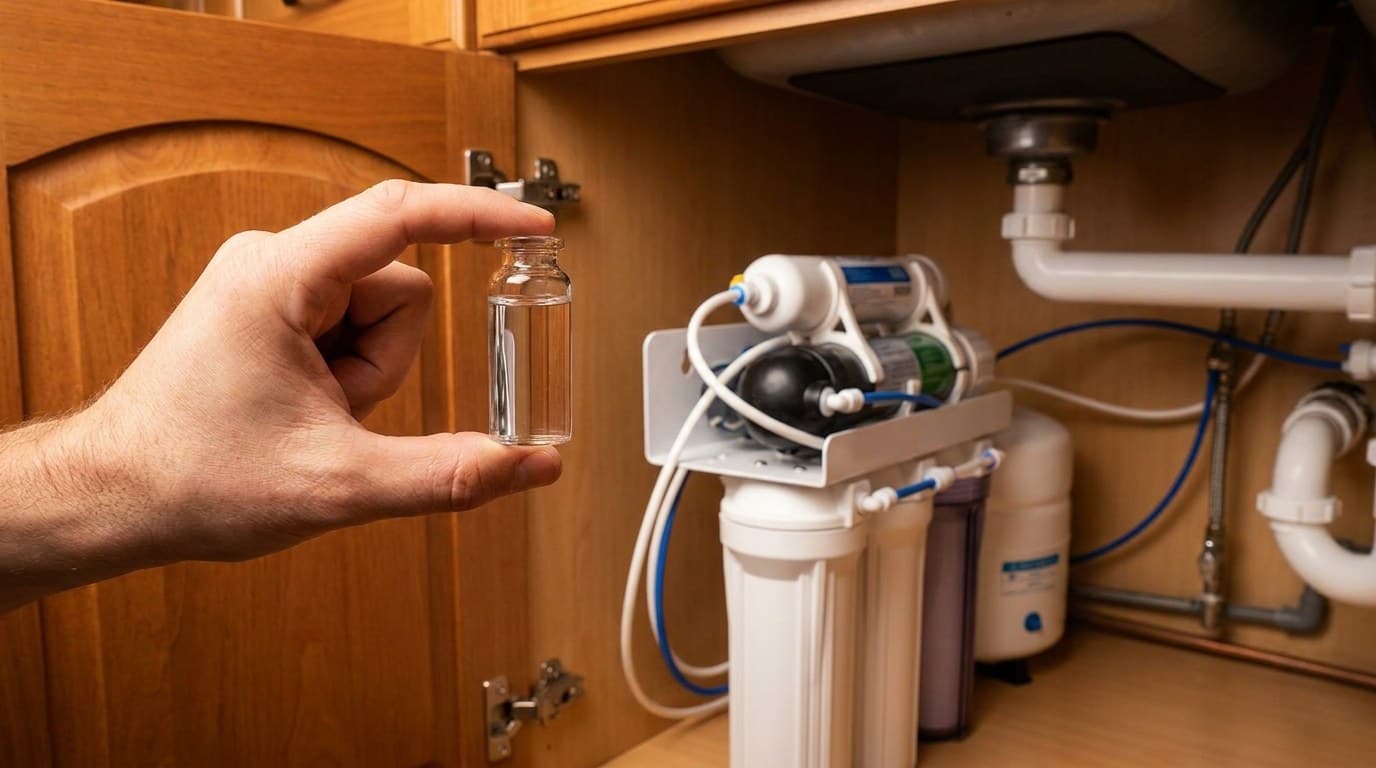
For San Diego County homes, an NSF/ANSI 58-certified under-sink reverse osmosis system is the most practical solution for reducing chromium-6 in drinking and cooking water. RO systems also reduce TDS, TTHMs, arsenic, and PFAS, which are additional contaminants detected in San Diego County water supplies. For households wanting whole-house coverage, a strong-base anion exchange system can remove chromate ions across all fixtures.
How does the Carlsbad desalination plant affect chromium-6 in San Diego water?
The Claude H. "Bud" Lewis Carlsbad Desalination Plant, operated by Poseidon Water and delivering water through the San Diego County Water Authority, uses seawater reverse osmosis to produce approximately 54 million gallons per day. Because the desalination process pushes seawater through RO membranes under high pressure, the resulting product water has extremely low concentrations of dissolved minerals, including chromium-6. SDCWA blends this desalinated supply with imported MWD water and distributes the blend through its regional delivery system.
The Carlsbad plant contributes about 10 percent of total San Diego County supply. The remaining 90 percent comes from imported Colorado River water, State Water Project water, and local groundwater. The blended delivery reduces average chromium-6 concentrations somewhat compared to what Colorado River water alone would contribute, but it does not eliminate chromium-6 from the system. Households on local groundwater sources are unaffected by the Carlsbad blend entirely, as their supply comes directly from basin wells before blending occurs.
For current blending ratios and water quality data from SDCWA, visit sdcwa.org.
How do San Diego County utilities treat water for chromium-6 before delivery?
California law requires that all regulated water utilities meet the 10 ppb MCL for hexavalent chromium. Utilities that draw from groundwater sources with naturally elevated chromium-6 have several treatment options: blending contaminated groundwater with lower-chromium imported supplies, ion exchange systems that selectively remove chromate ions, coagulation and filtration approaches that bind chromium to floc particles for removal, and reverse osmosis at the treatment plant level. The approach varies by district and is described in each utility's annual Consumer Confidence Report.
Helix Water District, which serves the El Cajon and La Mesa areas with a mix of local and imported sources, operates treatment facilities designed to manage multiple contaminants across its supply blend. Sweetwater Authority, serving Chula Vista and National City, operates Perdue Water Treatment Plant and other facilities that treat surface water and groundwater before delivery.
Treatment at the utility level is designed to meet the 10 ppb MCL, not the 0.02 ppb health goal. The gap between those two numbers is the reason that point-of-use treatment is widely recommended for households where health-conscious residents want to reduce chromium-6 beyond what the utility delivers. Each utility's treatment approach and resulting chromium-6 levels are documented in its annual Consumer Confidence Report, accessible through the SWRCB Drinking Water Watch portal.
What should San Diego County homeowners do right now about chromium-6?
Understanding your actual exposure is the first step. Here is a practical sequence for San Diego County residents:
- Get your utility's Consumer Confidence Report. Contact your water district and request the most recent CCR, or search for it through the SWRCB Drinking Water Watch database. Look specifically for hexavalent chromium or chromium-6 in the contaminant table. Compare the reported detection to 10 ppb (the MCL) and to 0.02 ppb (the public health goal).
- Know your water source. If you are in the Helix Water District, Sweetwater Authority, or Padre Dam service areas, check whether your address is served by groundwater wells or by imported supply, as concentrations can differ. Each district publishes a system map alongside its CCR.
- Test your tap if you are on a private well. Private wells in San Diego County are not covered by the CCR requirement and have no mandatory monitoring. Residents in East County who rely on private wells should arrange testing through a California ELAP-certified laboratory, particularly in areas near chromite-bearing geological formations in the Peninsular Ranges.
- Install NSF/ANSI 58-certified reverse osmosis for drinking water. A certified under-sink RO system provides an additional treatment barrier at the point of use, reducing chromium-6 as well as other contaminants common in San Diego water including TDS, TTHMs, and trace arsenic. Look for the NSF certification mark and verify the chromium-6 claim specifically in the NSF product registry at nsf.org.
- Consider whole-home filtration for broader coverage. If you want chromium-6 reduction at every faucet and fixture, a strong-base anion exchange system provides whole-house coverage. This is particularly relevant for households in the El Cajon or Chula Vista areas relying on groundwater-supplemented supply.
- Schedule a professional water assessment. On-site testing by a trained water specialist can assess hardness, TDS, pH, chloramines, and chromium-6 together, which matters in San Diego County where multiple water quality issues affect different treatment decisions. Use the ZIP code water checker to see what parameters are typical in your area before scheduling.
How does chromium-6 affect health at the concentrations found in San Diego water?
Hexavalent chromium is classified by the International Agency for Research on Cancer as a Group 1 carcinogen when inhaled. For drinking water exposure, California's Office of Environmental Health Hazard Assessment established the 0.02 ppb public health goal based on a theoretical one-in-one-million excess lifetime cancer risk from ingested chromium-6. The agency's 2011 risk assessment, affirmed in subsequent reviews, used data from the National Toxicology Program's studies showing evidence of carcinogenicity in animal studies involving oral chromium-6 exposure.
At the concentrations typical in San Diego County tap water, which generally fall below the 10 ppb MCL and often in the low single-digit ppb range, individual risk assessments are complicated by variables including consumption volume, duration of exposure, and individual health factors. The regulatory framework distinguishes between what utilities must achieve (10 ppb MCL) and what health science suggests is protective (0.02 ppb PHG). Both numbers are derived from the same underlying science. The full OEHHA risk assessment is available at oehha.ca.gov.
Frequently asked questions about San Diego County chromium-6
Does San Diego County tap water contain chromium-6?
Yes. The California State Water Resources Control Board's Drinking Water Watch database documents hexavalent chromium detections in multiple San Diego County water systems. Most detections fall below the 10 ppb Maximum Contaminant Level re-established in October 2024, but many exceed California's 0.02 ppb public health goal. The gap between those two numbers is the reason many San Diego households add NSF-certified point-of-use treatment.
Which San Diego County cities have the highest chromium-6 risk?
Cities served by water districts that draw from local groundwater face the most exposure to naturally occurring and legacy chromium-6. El Cajon and communities served by Helix Water District draw from the El Cajon Basin, where SWRCB monitoring has documented hexavalent chromium detections. Chula Vista and National City, served by Sweetwater Authority, also draw on supplemental groundwater. Residents can look up their specific utility through the SWRCB Drinking Water Watch tool at waterboards.ca.gov.
What is the source of chromium-6 in San Diego County water?
San Diego County's chromium-6 comes from two sources. Natural geological processes release hexavalent chromium from chromite-bearing rock into groundwater across the Peninsular Ranges and surrounding formations that feed East County basins. Imported Colorado River water, which supplies roughly 80 percent of San Diego County through the San Diego County Water Authority, also carries naturally occurring chromium-6 from geological formations in the Southwest.
Does a standard water filter remove chromium-6?
No. Activated carbon pitcher filters and faucet filters certified under NSF/ANSI Standard 42 are designed for taste and odor, not for chromium-6 removal. For hexavalent chromium reduction, use a reverse osmosis system certified under NSF/ANSI Standard 58, which independently tests and verifies chromium-6 reduction. Verify a specific product's NSF certification for chromium-6 at the NSF product registry before purchase.
How do I find out how much chromium-6 is in my San Diego water?
Every California water utility publishes an annual Consumer Confidence Report listing contaminant detections, including hexavalent chromium. Request it from your utility directly, or search the California State Water Resources Control Board's Drinking Water Watch database at waterboards.ca.gov by your utility name. Private well owners in San Diego County are not covered by utility CCRs and should arrange testing through a California ELAP-certified laboratory.
Does the Carlsbad desalination plant remove chromium-6?
Yes. The Claude 'Poseidon' Carlsbad desalination facility uses seawater reverse osmosis membranes to produce its supply, and the RO process removes chromium-6 as part of the overall desalination treatment train. However, the Carlsbad plant supplies approximately 10 percent of San Diego County's total water. Most of the county's supply comes from imported Colorado River and State Water Project sources through SDCWA, which requires separate evaluation.
What this guide covers vs. what it does not
This guide is based on publicly available California SWRCB monitoring data, utility Consumer Confidence Reports, California OEHHA publications, EPA SDWA documentation, and NSF certification standards. It does not contain real-time monitoring data. Chromium-6 levels at your specific address depend on which utility serves you, their current source blend, treatment approach, and your location relative to groundwater well fields and delivery infrastructure. Always verify current levels with your utility CCR or the SWRCB Drinking Water Watch database before making filtration decisions. Private well owners should arrange independent laboratory testing.
Related guides and services
- Chromium-6 in Southern California: complete guide
- Chromium-6 in the San Gabriel Valley
- PFAS in Southern California water
- Arsenic in Southern California water
- Reverse osmosis guide for Southern California
- Reverse osmosis installation
- Whole-home filtration systems
- San Diego County water treatment service area
- Check your ZIP code water quality
Last updated: August 11, 2026. Data sources: California SWRCB Drinking Water Watch, California OEHHA Chromium-6 Public Health Goal (2011, affirmed 2023), California SWRCB MCL update (October 2024), EPA SDWA Chromium in Drinking Water, USGS Water Resources, NSF International Standard 58, San Diego County Water Authority annual water quality reports, Helix Water District Consumer Confidence Report, Sweetwater Authority Consumer Confidence Report.
Free on-site water test in San Diego County. No charge. No commitment. Real data.
We test your kitchen tap with calibrated field meters for hardness, TDS, pH, and chloramine. For chromium-6, we walk you through how to request certified lab testing through a California ELAP-approved laboratory. You see the results before any filtration system is discussed.
- Free water test in your kitchen. Nothing charged until you see the lab numbers.
- Three system options, all-in number, four financing terms shown side-by-side.
- 5-year comprehensive warranty. 90-day money-back guarantee.
- Same-day install in most ZIPs. Permits pulled by us.
Pick a window for your free water test.
A SoCal Water Treatment tech meets you in your kitchen, runs the test, sends the lab sample. No charge, no commitment.
Request your free water test and we will confirm a window with you directly, usually within the hour.