Reverse osmosis for San Diego County: Carlsbad desalination, TDS, arsenic, and NSF 58 explained.
San Diego County delivers some of the highest-TDS tap water in California due to the Carlsbad desalination blend. An NSF 58-certified RO system reduces TDS by 94 to 99 percent and removes arsenic, PFAS, and TTHMs.
San Diego County delivers some of the highest-TDS tap water in California, partly because the regional supply blends imported Colorado River water with output from the Carlsbad desalination plant. Blended supply TDS runs 450 to 560 mg per liter across most SD distribution systems. An NSF 58-certified reverse osmosis system at the kitchen tap reduces TDS by 94 to 99 percent, removes arsenic, eliminates PFAS compounds, and solves the flat or salty taste that many SD homeowners notice. This guide explains what is in San Diego tap water, what it means for your household, and how an RO system addresses each contaminant based on independent testing data.
What is in San Diego tap water and what does an RO system do about it.
The table below is drawn from the San Diego County Water Authority Annual Report, the California State Water Resources Control Board monitoring database, and utility Consumer Confidence Reports. Contaminant levels reflect the blended supply across SD distribution systems; your specific utility and ZIP code may vary. Use the water checker to pull ZIP-level data.
| Contaminant | SD county level | CA / EPA standard | RO removal rate |
|---|---|---|---|
| Total dissolved solids (TDS) | 450 to 560 mg/L (blended supply including Carlsbad desal) | 500 mg/L secondary standard (taste threshold) | 94 to 99 percent (membrane rejection) |
| Total hardness | 17 to 25 gpg (varies by service area and seasonal blend) | No MCL; 170 mg/L as CaCO3 secondary aesthetic goal | 94 to 99 percent (calcium and magnesium rejection) |
| Arsenic (inorganic) | Up to 1.4 ppb (groundwater blend areas) | 10 ppb MCL; 0.004 ppb public health goal | 85 to 97 percent (NSF 58 certified) |
| Total trihalomethanes (TTHMs) | Up to 28 ppb (varies by disinfection and distribution age) | 80 ppb MCL | Greater than 95 percent (activated carbon pre-filter plus RO) |
| PFOA and PFOS (PFAS) | Detectable in multiple SD water systems | 4 ppt (EPA MCL, April 2024) | Greater than 94 percent (NSF 58 verified) |
| Chromium-6 (hexavalent chromium) | Detectable; varies by utility and groundwater influence | 10 ppb MCL (California, October 2024); 0.02 ppb public health goal | 85 to 97 percent (NSF 58 certified) |
SD contaminant levels sourced from SDCWA Annual Report, California State Water Resources Control Board monitoring data, and utility Consumer Confidence Reports. RO removal rates reflect NSF/ANSI 58 certification testing at municipal supply concentrations. Actual results vary by feedwater quality and system configuration.
The Claude Gordon Desalter, operated by Poseidon Water at Carlsbad, began delivering up to 50 million gallons per day of desalinated Pacific Ocean water to the San Diego County Water Authority supply in 2015. It is the largest seawater desalination plant in the Western Hemisphere.
The desalination process uses reverse osmosis membranes to produce very low-TDS permeate water. That permeate is then blended with imported Colorado River water and State Water Project supplies before distribution. The resulting blend arrives at most SD taps with TDS between 450 and 560 mg per liter depending on the seasonal blend ratio. This is above the 500 mg per liter secondary taste standard, which is why many SD residents notice a flat or mineral character.
SDCWA desalination supply overviewParts of San Diego County, particularly areas drawing from groundwater or blended sources in the eastern portions of the county, have detected arsenic at concentrations up to 1.4 parts per billion. The federal MCL is 10 ppb, but the EPA and the International Agency for Research on Cancer classify inorganic arsenic as a Group 1 human carcinogen with no established safe threshold at very low concentrations.
Standard pitcher filters and carbon block systems do not reliably remove arsenate ions from drinking water. NSF/ANSI Standard 58-certified reverse osmosis systems are the EPA-recognized residential treatment for arsenic, achieving 85 to 97 percent reduction at the point of use.
California State Water Resources Control Board: arsenic dataWhat contaminants are actually in your SD tap water? The answer is at your kitchen sink, not in a brochure.
A SoCal Water Treatment technician tests your kitchen tap with calibrated strips, meters, and a sample sent to an independent lab. No charge. No pressure. The results tell you which system, if any, your specific water actually needs.
- Free water test in your kitchen. Nothing charged until you see the lab numbers.
- Three system options, all-in number, four financing terms shown side-by-side.
- 5-year comprehensive warranty. 90-day money-back guarantee.
- Same-day install in most ZIPs. Permits pulled by us.
Why San Diego County homes benefit from pairing RO with a water softener.
At 17 to 25 grains per gallon, San Diego County water is consistently hard throughout the year. The Colorado River water that makes up a large portion of the regional import supply carries dissolved calcium and magnesium from the river's passage through calcium-rich geology in the Southwest. Hard water deposits scale on water heaters, reduces dishwasher efficiency, leaves mineral spots on glassware and shower doors, and shortens appliance life. The water hardness guide for Southern California explains how SD hardness compares across the region.
A whole-home water softener resolves hardness at every faucet, shower, and appliance. It works by passing hard water through a resin bed that exchanges calcium and magnesium ions for sodium ions, producing soft water throughout the home.
Installing an NSF 58-certified reverse osmosis system downstream of the softener gives you both layers of protection. The softener handles whole-home scale. The RO membrane then removes the sodium added by the softener, plus TDS, arsenic, PFAS compounds, TTHMs, and chromium-6, delivering purified water at the kitchen tap. Softened feedwater also extends RO membrane service life.
We install both systems together in Carlsbad, Encinitas, San Diego, and throughout the county. Use the water checker to see contaminant data for your ZIP code, or contact us to schedule a free in-home water test.
- Under-sink RO only (NSF 58)Whole-home hardness: NoArsenic: Yes (85 to 97%)PFAS: Yes (94%+)TDS: Yes (94 to 99%)
- Water softener onlyWhole-home hardness: Yes (all fixtures)Arsenic: NoPFAS: NoTDS: Partial (removes hardness minerals)
- Softener + RO (recommended for SD)Whole-home hardness: Yes (all fixtures)Arsenic: Yes (85 to 97%)PFAS: Yes (94%+)TDS: Yes (94 to 99%)
Removal rates reflect NSF/ANSI 58 certification testing and standard softener ion exchange performance. Source: NSF International at nsf.org.
RO installation across San Diego County.
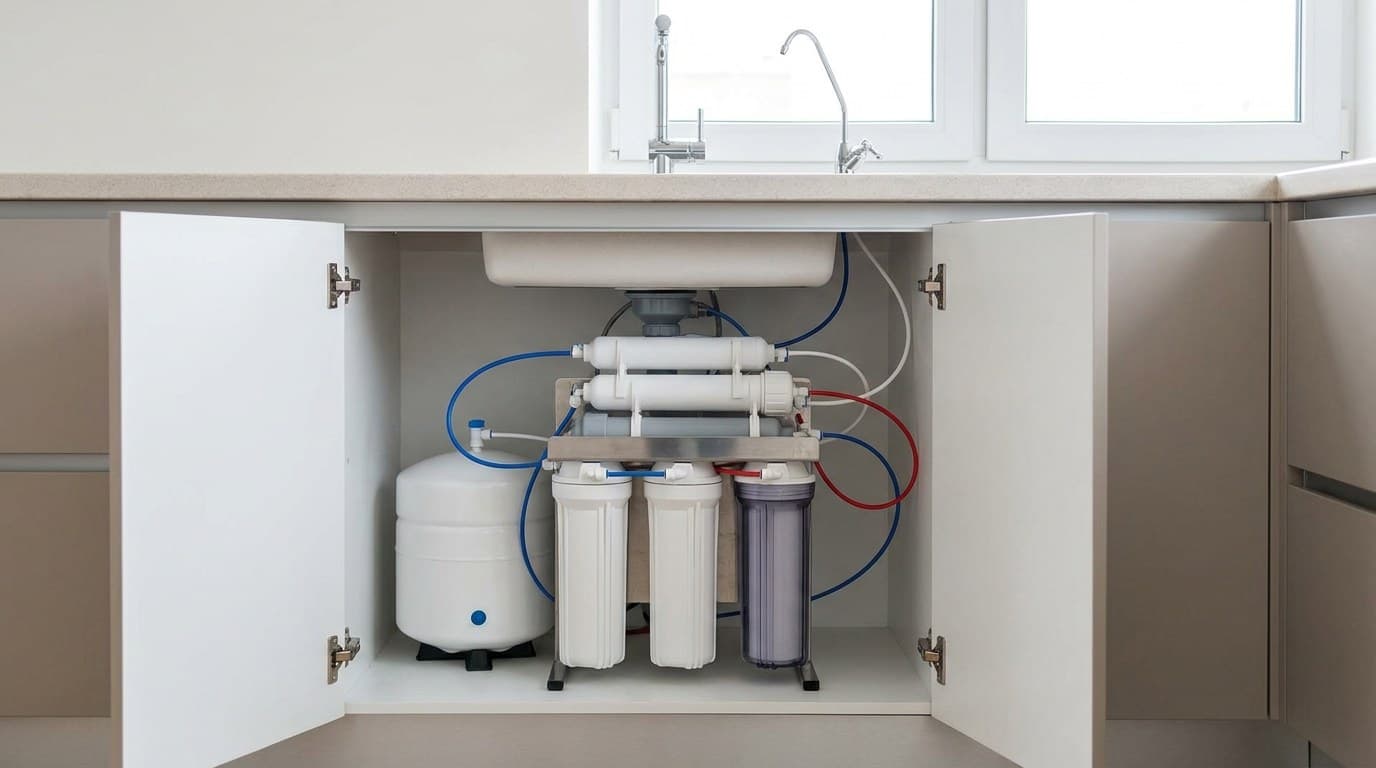
We install NSF 58-certified five-stage RO systems throughout San Diego County. Each installation is sized to the local water profile, because TDS, arsenic levels, and disinfection method vary by utility and ZIP code within SD.
City utilities blend SDCWA import and local reservoirs; TDS 450 to 520 mg/L typical
Closest to the Poseidon desal plant; supply includes direct desal contribution; TDS can reach 560 mg/L
Olivenhain MWD supply; TDS 480 to 540 mg/L; elevated hardness 18 to 24 gpg
Valley Center MWD blend; groundwater influence; arsenic monitoring required
Sweetwater Authority supply; Colorado River blend; TTHMs monitored
Contact us to confirm coverage for your ZIP code
We have completed more than 5,000 installations across Southern California since 2009, including throughout San Diego County. All systems carry a 5-year warranty and a 90-day satisfaction guarantee. View the San Diego County area page or contact us to confirm coverage.
Reverse osmosis questions for San Diego County homeowners.
Why does San Diego water taste salty or flat?
San Diego County draws a significant share of its supply from the Claude Gordon Desalter at Carlsbad, which opened in 2015 and adds up to 50 million gallons per day of desalinated Pacific Ocean water to the regional blend. While the Poseidon desalination process removes virtually all dissolved solids from seawater, the final blended supply still carries elevated TDS, typically 450 to 560 mg per liter across SD distribution systems. High TDS produces a flat or mineral taste that many households notice. An NSF 58-certified under-sink RO system reduces TDS by 94 to 99 percent, eliminating the taste issue at the kitchen tap. Source: San Diego County Water Authority Annual Report at sdcwa.org.
Does reverse osmosis remove arsenic from San Diego water?
Yes. San Diego County water, particularly in areas drawing from groundwater and blended desal sources, can contain arsenic at concentrations up to 1.4 parts per billion. While this is below the 10 ppb federal MCL, the EPA acknowledges no safe level of inorganic arsenic based on cancer risk at low concentrations. NSF/ANSI Standard 58-certified reverse osmosis systems achieve 85 to 97 percent arsenic reduction, making RO the preferred residential treatment for arsenic in drinking water. Verify your utility's specific arsenic data in the most recent Consumer Confidence Report. Source: California State Water Resources Control Board at waterboards.ca.gov.
What NSF certification does a San Diego RO system need?
NSF/ANSI Standard 58 is the governing certification for residential point-of-use reverse osmosis systems. For San Diego water, look for certification claims covering total dissolved solids reduction, arsenic, PFAS (PFOA and PFOS), and TTHMs. NSF 58 requires independent laboratory testing, not manufacturer self-reporting. You can verify any system's contaminant-specific claims through the NSF Certified Drinking Water Treatment Units database at nsf.org before purchase. California also requires point-of-use systems sold here to meet Title 22 standards, which align with NSF 58.
How hard is San Diego tap water and does RO help?
San Diego County water hardness typically runs 17 to 25 grains per gallon depending on the service area and seasonal blending ratio between imported Colorado River water, State Water Project supplies, and Carlsbad desalinated water. At this hardness level, scale accumulates in water heaters, dishwashers, and plumbing fittings. A water softener is the right tool for whole-home hardness control. An under-sink NSF 58-certified RO system complements the softener by removing the sodium added by ion exchange, along with TDS, arsenic, PFAS, and TTHMs, at the drinking water tap.
Are PFAS chemicals a concern in San Diego County water?
PFAS compounds, including PFOA and PFOS, have been detected in water systems across San Diego County. The EPA finalized maximum contaminant levels of 4 parts per trillion for PFOA and PFOS in April 2024, making these among the most strictly regulated substances in United States drinking water. NSF 58-certified reverse osmosis systems achieve greater than 94 percent removal of PFOA and PFOS at the point of use. Check your utility's most recent Consumer Confidence Report or the EPA's PFAS drinking water database for detected levels at your specific supply. Source: U.S. EPA at epa.gov.
Is whole-home reverse osmosis right for a San Diego home?
For most San Diego households, a point-of-use under-sink RO system at the kitchen tap is the practical choice, not a whole-home system. Whole-home RO generates substantial waste water, requires high inlet pressure, and involves significant ongoing filter and membrane costs. The better whole-home solution for SD is a water softener to address hardness at every fixture, paired with a five-stage NSF 58-certified under-sink RO system for purified drinking and cooking water. A free in-home water test from our technicians will confirm which combination your actual water quality warrants.
- Hundreds of installations across San Diego County
- Top-rated on Google across Southern California
- High customer satisfaction rate
- Systems tested to ANSI 42, 53, and 58 standards
- CA Contractor License C-55 #1085921
- 5-year warranty on tanks, valves, and labor
- 90-day money-back guarantee
- Same-day installation available in SD service cities
Find out what is actually in your San Diego County tap water.
A SoCal Water Treatment technician tests your kitchen tap with calibrated equipment and sends a sample to an independent lab. If your water shows elevated TDS, arsenic, PFAS, or chromium-6, we size a system to your specific numbers. No charge for the test. No obligation.
- Free in-home water test at your kitchen sink
- Independent lab results within 24 hours
- NSF 58-certified RO systems, same-day installation available in SD
- 5,000+ installations across Southern California since 2009
- 5-year warranty on tanks, valves, and labor
- 90-day satisfaction guarantee
Pick a window for your free water test.
A SoCal Water Treatment tech meets you in your kitchen, runs the test, sends the lab sample. No charge, no commitment.
Request your free water test and we will confirm a window with you directly, usually within the hour.
Cleaner water at every tap by sundown. No upsell theater.
Free water test in your kitchen. Lab report in 24 hours. 5-year warranty. 90-day money-back.